Showing posts sorted by relevance for query the Somme. Sort by date Show all posts

Thursday, 30 June 2016

In memory of just one soldier of over 300,000, who were slaughtered at the Somme in 1916


https://www.pafa.org/sites/default/files/styles/slideshow_large/public/images/slideshows/SARGENT-GASSED-IWM,LONDON.jpg?itok=l5KXO9be

DULCE ET DECORUM EST by Wilfred Owen

Bent double, like old beggars under sacks, 
Knock-kneed, coughing like hags, we cursed through sludge, 
Till on the haunting flares we turned our backs 
And towards our distant rest began to trudge. 
Men marched asleep. Many had lost their boots 
But limped on, blood-shod. All went lame; all blind; 
Drunk with fatigue; deaf even to the hoots
Of tired, outstripped Five-Nines that dropped behind.
Gas! Gas! Quick, boys! – An ecstasy of fumbling, 
Fitting the clumsy helmets just in time; 
But someone still was yelling out and stumbling, 
And flound'ring like a man in fire or lime . . . 
Dim, through the misty panes and thick green light, 
As under a green sea, I saw him drowning. 
In all my dreams, before my helpless sight, 
He plunges at me, guttering, choking, drowning. 
If in some smothering dreams you too could pace 
Behind the wagon that we flung him in, 
And watch the white eyes writhing in his face, 
His hanging face, like a devil's sick of sin; 
If you could hear, at every jolt, the blood 
Come gargling from the froth-corrupted lungs, 
Obscene as cancer, bitter as the cud 
Of vile, incurable sores on innocent tongues, 
My friend, you would not tell with such high zest 
To children ardent for some desperate glory, 
The old Lie; 'Dulce et Decorum est 
Pro patria mori'.


Leonard Thomas Veater, Canadian Mounted Regiment. Killed 30.9.1916

 The Somme. In memory of
Private
Leonard Thomas Veater
September 30, 1916
Military Service:

Service Number:
135591
Age:
28
Force:
Army
Unit:
2nd Canadian Mounted Rifles (British Columbia Regt.)
Additional Information:

Son of Thomas and Mary Jane Veater, of Chew Magna, Bristol, England.


https://www.google.co.uk/search?q=chew+magna+church+images&rlz=1C1ARAB_enGB463GB464&espv=2&biw=1024&bih=713&tbm=isch&tbo=u&source=univ&sa=X&ved=0ahUKEwjX396N9s_NAhUiIcAKHYO6DzEQsAQIGw#imgrc=pg_OUNOJ5exfOM%3A


Commemorated on Page 176 of the First World War Book of Remembrance. Request a copy of this page.

Burial Information:

Cemetery:
STUMP ROAD CEMETERY ; Somme, France
Grave Reference:
B. 72.
Location:
Grandcourt is a village about 12 kilometres north-east of Albert. The STUMP ROAD CEMETERY (signposted in the centre of village) lies about one kilometre south of Grandcourt, some 500 metres along a single track lane (suitable for cars) off the road (D151) Grandcourt-Thiepval.

Newspaper Clipping
http://www.veterans.gc.ca/eng/remembrance/memorials/canadian-virtual-war-memorial/detail/302333?Leonard%20Thomas%20Veater

Newspaper Obituary
http://www.veterans.gc.ca/eng/remembrance/memorials/canadian-virtual-war-memorial/detail/302333?Leonard%20Thomas%20Veater

(The information contained in this newspaper report appears factually incorrect in several respects)


Sons of England War Memorial
http://www.veterans.gc.ca/eng/remembrance/memorials/canadian-virtual-war-memorial/detail/302333?Leonard%20Thomas%20Veater


Todmorden Sons of England (SOE) war memorial
http://www.veterans.gc.ca/eng/remembrance/memorials/canadian-virtual-war-memorial/detail/302333?Leonard%20Thomas%20Veater


FRANCE - STUMP ROAD CEMETERY, GRANDCOURT

In order to ensure security at the commemorative events taking place on 1 July 2016, marking the centenary of the First Day of the Battle of the Somme, French Authorities will be enforcing a security cordon in the area prohibiting access to all except those who are attending one of the events. The cordon may be subject to change by the French authorities. A map showing the security cordon and the Commonwealth War Graves Commission sites we expect to be inaccessible as a result of the cordon from mid-afternoon on 30 June until early morning on 2 July.

http://www.cwgc.org/find-a-cemetery/cemetery/30901/STUMP%20ROAD%20CEMETERY,%20GRANDCOURT
Country:
France
Locality:
Somme
Identified Casualties:
213

Location Information

Grandcourt is a village about 12 kilometres north-east of Albert.

The Cemetery (signposted in the centre of village) lies about one kilometre south of Grandcourt, some 500 metres along a single track lane (suitable for cars) off the road (D151) Grandcourt-Thiepval.

Historical Information

The village of Grandcourt was reached by men of the 36th (Ulster) Division on the 1st July 1916, but it could not be held. It was occupied by the 63rd (Royal Naval) Division on the 7th February 1917, after a series of local attacks begun in November 1916. Stump Road Cemetery was made by the 7th Buffs in the following month.

There are now over 250, 1914-18 war casualties commemorated in this site. Of these, over one-fifth are unidentified (mostly 18th Division men). All fell in the period July 1916 to February 1917.

The Cemetery covers an area of 399 square metres and is enclosed by a low wall.

http://www.cwgc.org/find-a-cemetery/cemetery/30901/STUMP%20ROAD%20CEMETERY,%20GRANDCOURT


From: https://en.wikipedia.org/wiki/Battle_of_Thiepval_Ridge

"The Reserve Army commander Lieutenant-General Sir Hubert Gough ordered the attack for 26 September at 12:35 p.m., to push the Germans off the high ground of the Thiepval Ridge, from Courcelette 6,000 yards (5,500 m) west to Schwaben Redoubt, by the Canadian Corps under Lieutenant-General Julian Byng and II Corps commanded by Lieutenant-General Claud Jacob, each with two divisions in the attack. Three stages were set for the advance, with halts of ten minutes and one hour before the final advance. The Canadian Corps was to provide a flank guard on the right, by taking the German trenches on the spur north-west of Courcelette, the right of II Corps was to take Zollern Redoubt Zollern-Feste in the second stage of the advance and Stuff Redoubt at the final objective on the crest of the ridge. On the left the corps was to take Thiepval in the second stage and then reach Schwaben Redoubt, which overlooked the slope down to St Pierre Divion. It was emphasised that the Germans were to be driven off all the crest, to deny the Germans observation towards Albert and gain observation of the Ancre valley. The German front line west of Thiepval was to be captured during the advance.[3]
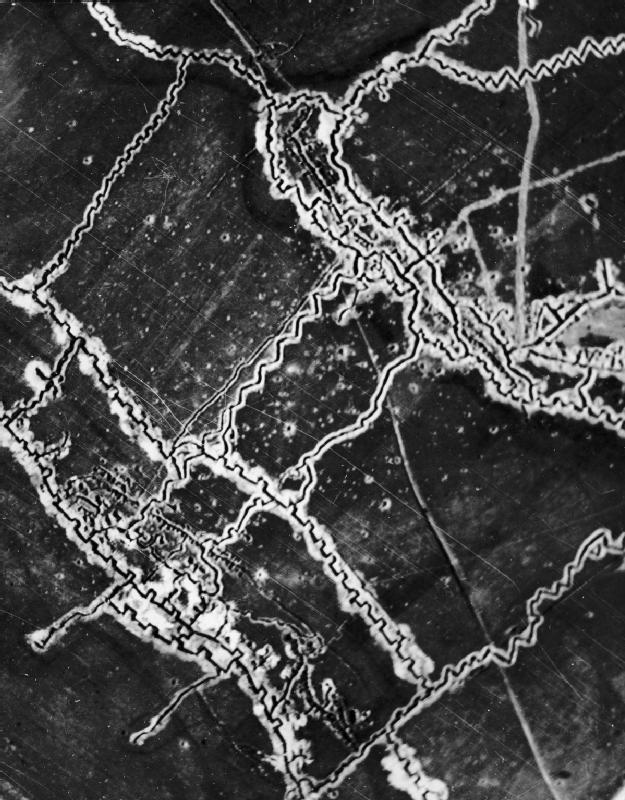

https://upload.wikimedia.org/wikipedia/commons/a/a1/Schwaben_Redoubt_aerial_photograph_10-05-1916_IWM_HU_91107.jpg

"Orders for the capture of more objectives and to gain ground at every opportunity, were issued on 28 September and were intended to combine with the Fourth Army attacks planned for early October, which became known as the Battle of Le Transloy; Stuff and Schwaben redoubts were to be captured by 29 September and Stuff Trench by 1 October.[8]"

"The German front position on the south face of Thiepval was about 300 yards (270 m) in front of the village; about 1,000 yards (910 m) back was the second line, Staufen Riegel ("Stuff Trench" to British troops and "Regina Trench" to the Canadians) about 1,000 yards (910 m) and another 1,000 yards (910 m) further back was the third line,Grandcourt Riegel (Grandcourt Trench). The cellars under Thiepval Château had been extended into a complex of tunnels, used as storehouses and shelters. A sunken road running up the middle of the village to the cemetery, had been lined with dug-outs and in the original front-line to the west were 144 deep dug-outs.[6]"


https://en.wikipedia.org/wiki/Battle_of_Thiepval_Ridge#/media/File:N%C3%A4chtliche_Szene_bei_Thiepval.jpg

"On 28 September, a cavalry patrol moved forward on the right of the 6th Brigade, 2nd Canadian Division at dawn but was quickly stopped by machine-gun fire. The brigade dug in facing north-east beyond the German practice trenches and a battalion advanced north up Courcelette Trench, meeting much German machine-gun fire from Regina Trench."

"On 29 September, the 8th Brigade from the 3rd Canadian Division attacked at noon with the 11th Division on the left and reached Hessian Trench in places, which were lost and then regained during German shelling and counter-attacks. In the II Corps area, the 11th Division attacked Stuff Redoubt and Hessian Trench to the right, most of which was captured and touch gained with the Canadians, while the attack on the redoubt failed. After battalion reliefs in the 18th Division, a bombing fight began around 7:30 a.m. along the western edge of Schwaben Redoubt, which lasted all day; the ground gained could not be held and the battalion later relieved troops in the captured German front system. On 30 September, the 11th Division resumed the attack on Stuff Redoubt at 4:00 p.m., with bombing parties advancing west along Hessian Trench and along ZollernTrench, which by nightfall had taken the southern half of the redoubt. Canadian bombers assisted the capture of Hessian Trench and the division was relieved by the 25th Division overnight. A dawn counter-attack drove the 18th Division from the south and west sides of Schwaben Redoubt; the south side was recaptured and the north side of the redoubt was taken at4:00 p.m. Another German attack at 9:00 p.m. retook the north face, up to the entrance to Stuff Trench on the right.[20]"


From: http://www.farmborough.org.uk/wp-content/uploads/2014/11/FF105-Jul2014.pdf

The Great War - a war that changed everything!

IT'S ALMOST 100 YEARS since the First World War started.

It began on July 28 1914 with the UK entering the conflict at midnight on August 4 1914 following the invasion of Belgium by Germany. The total number of military and civilian casualties exceeded 37 million - more than 16 million deaths and 20 million wounded - ranking it among the deadliest conflict in human history.

Prior to her sudden death, Ruth Flower wrote her memoir about her mother's family with five sons that enlisted in the 1914/18 war. A war which finished forever a way of life which had continued almost unaltered for centuries.

"My mother, Amy Beatrice Beish, nee Veater, had five brothers who enlisted in the 14/18 war. Mother, the youngest of 9 children, was born at Chew Magna, her father was the local saddler. The family home is still there - it is now an Estate Agent's office.

picture of Parish Church of St. Andrew, Chew Magna.
http://gb.geoview.info/parish_church_of_st_andrew_chew_magna,12064110p

"Arthur, mother's eldest brother who was also a saddler, did not enlist in the Army. He lived at Pensford and tended the pit ponies at Pensford Pit until its closure.

"Three of mother's brothers, Walter, George and Leonard emigrated to Canada in the early 1900's and enlisted in 1914 or 1915 when they were sent to train at a military camp at Niagara.  "Two other brothers, Percy and Morris who lived at Chew Magna, also enlisted. "Certainly four of them were sent to the Somme. I am not quite sure where Morris served.

I enclose part of a letter that Leonard wrote to my mother from the camp at Niagara. (Will not copy to here unfortunately) Sadly the letter to Mother was not treasured as she had treasured it. I happened to find this partpage when I cleared out my sister's house after her death.

"Leonard was mother's favourite brother. He had wanted her to go with them when they went to Canada. I still have a gold locket that he sent to Mother. I know he also sent her a ring and a watch; they are lost I imagine.

"I visit France quite often these days and one day I was speaking to a friend there and told her about my mother's brothers who came to France to fight in the 14/18 war. I told her about Mother's brother who was killed at the Somme and how she was always upset at the Armistice services and that I had promised mother that if I ever had the opportunity I would find his grave and visit the cemetery. This was, of course, years before computers and there seemed little likelihood of it happening.

My friend said, "Ruth, I was born in the area. Find the details and I will take you there". "Now with computers, we are able to search for information and I did. I found the grave's location and its plot number. I took the information to France and my friend drove me to the area where we found the grave of Leonard Veater.

It was quite an emotional experience and I was surprised by the feelings that rose in me as Leonard died years before I was born. I had never met him.

"I thought of my mother as I placed a small cross with a poppy attached in the earth. I felt happy that I had been able to keep a promise I had made to Mother many years before.

"I have no information about his death - why or how it happened - but with the aid of a computer I believe I can find out. The grave is in a small cemetery and all the soldiers at rest there are Canadian.

 "What had the war done to the four boys that returned from the war?" Find out in next month's Flyer. (This never appears, cut short we presume by Ruth's unexpected and sudden death (see below))


https://www.google.co.uk/search?q=chew+magna+church+images&rlz=1C1ARAB_enGB463GB464&espv=2&biw=1024&bih=713&tbm=isch&tbo=u&source=univ&sa=X&ved=0ahUKEwjX396N9s_NAhUiIcAKHYO6DzEQsAQIGw#imgrc=6zNrw9RzWEsNyM%3A

The family house and shop (with three round top windows) where Leonard and his siblings lived, can be seen at the bottom of the street. The photograph is roughly contemporary to the events described.


Obituary - Ruth Flower RUTH FLOWER, Parish Councillor Public Speaker, Actress and 'DJ', died s~ddenly at her home on Monday May 26 aged 83. Ruth was born on March 29 1931 and was the third child of Charles and Amy Beish who lived in The Street, Farmborough. She was educated at Farmborough Church of England Primary and Timsbury Secondary Modern Schools and after completing her education found employment in the retail trade at Keynsham. Ruth's father, Charlie, was a local preacher at The Batch Methodist Church where she sang in the choir. She was very much involved in village life and in 1947 Ruth took the eye of the judges at a competition to find Farmborough's Carnival Queen and won! It was on a night out with other locals when attending a dance that Ruth met her husband to be, Ron Flower. They immediately fell for each other and so started a fantastic love affair that lasted throughout their lives and most likely beyond. Ron had recently been demobbed from the Royal Engineers and was the proud owner of a Vellocette motor cycle. Both Ron and Ruth would go off on trips to Weston-super-Mare and Cheddar. They were inseparable and after much courtship they married in 1952 and moved into a cottage at Hobbs Wall. Eventually they took over a shop at the bottom of The Batch, now Stream House, and it was there, in 1959, their son Simon was born. Ron landed a job with the MOD which meant that the family had to move to Bewdly in Worcestershire and following a few more moves they ended up in Winslow where Ruth opened a fabric shop, Ruth's Fabrics The 1980s saw another change when Simon embarked on a diving career in the USA and Ron and Ruth moved to Portugal. Sadly Ron died in 1998 and it was then Ruth decided to return to the UK With her talent for singing Ruth had been a member of a local amateur dramatic society where she was well suited and a regular choice for the role of principal boy in the "Stratton Players" pantomimes. On her return to England she soon became very involved with the entertainment side of life. Ruth had bit parts in "Casualty" and also had a role in the film "Stardust" with Robert De Niro. She took part in advertising campaigns for The Nationwide Building Society and Oakhouse Foods. Known as "Mamy Rock" Ruth was a DJ and travelled all over the world sharing her ideas of life and how to live it. She even performed at the Glastonbury Festival and is listed in the Guinness Book of Records as the oldest working DJ. Despite all of this Ruth managed to fit in the work of a Parish Councillor. How did she do it? Ruth's death was a shock to us all. During her lifetime she touched the hearts and lives of many and we shall miss her. Ruth is survived by her son, Simon, daughter-in-law Tracey and grandson Franklyn Ruth Flower born March 29 1931, died May 26 2014.

"Nothing new under the sun."

http://www.baberfamilytree.org/vera/doc/st-and-hist.htm


http://www.baberfamilytree.org/Albums/Images/BaberTomb1.jpg


http://www.picturesofengland.com/img/L/1002644.jpg


From A. E. Houseman - A Shropshire Lad.


VIII
          "Farewell to barn and stack and tree,
           Farewell to Severn shore.
          Terence, look your last at me,
           For I come home no more.

          "The sun burns on the half-mown hill,
           By now the blood is dried;
          And Maurice amongst the hay lies still
           And my knife is in his side."

          "My mother thinks us long away;
           'Tis time the field were mown.
          She had two sons at rising day,
           To-night she'll be alone."

          "And here's a bloody hand to shake,
           And oh, man, here's good-bye;
          We'll sweat no more on scythe and rake,
           My bloody hands and I."

          "I wish you strength to bring you pride,
           And a love to keep you clean,
          And I wish you luck, come Lammastide,
           At racing on the green."

          "Long for me the rick will wait,
           And long will wait the fold,
          And long will stand the empty plate,
           And dinner will be cold."

XXXVIII

          The winds out of the west land blow,
           My friends have breathed them there;
          Warm with the blood of lads I know
           Comes east the sighing air.

          It fanned their temples, filled their lungs,
           Scattered their forelocks free;
          My friends made words of it with tongues
           That talk no more to me.

          Their voices, dying as they fly,
           Thick on the wind are sown;
          The names of men blow soundless by,
           My fellows' and my own.

          Oh lads, at home I heard you plain,
           But here your speech is still,
          And down the sighing wind in vain
           You hollo from the hill.

          The wind and I, we both were there,
           But neither long abode;
          Now through the friendless world we fare
           And sigh upon the road.

Tuesday, 27 October 2015

FISK, BRAND, PAXMAN


These are 'old posts' transferred from the 'Inquiring Minds' site that has stopped operating with the tragic and unexpected demise of its 'Editor', Malcolm Treacher, on the 21st August, 2015. He and it will be sadly missed by many.

This was the greatest crimes of the 21st Century, yet has never been subject to a criminal investigation! – Tim Veater

One Response to [UK-911-Truth] Video: Russia Today TV Exposes 9/11 Inside Job; Mysterious deaths of key 9/11 Truth Eyewitnesses; Pentagon video shows no plane; Music videos on 9/11 Inside Job; A history of false flag operations – Alex J.

Tim Veater
This was the greatest crimes of the 21st Century, yet has never been subject to a criminal investigation! On it was predicated further outrages in the invasion of two countries, still continuing. It is a given, that conspiracy was necessarily involved, it is just a question as to who the conspirators were, and for what authority they were working.
The evidence is now overwhelming that the official version propounded by the American Government is directly contradicted by science, witnesses – expert and otherwise, and other sources. The fact that the American Government refuses to face facts and clings to its own preposterous explanation of events, must entail complicity in the crime itself. Could there be a more damning conclusion or a more profound undermining in everything America claims to stand for? Only the enormity of the charge prevents the truth being exposed but exposed it will be.
That a Government that claims to espouse constitutional and democratic principles, could conspire to kill thousands of its own, expose hundreds of thousands of others to deadly chemicals and psychological trauma, actively cover up the crime by removing evidence, and obstruct the proper investigation of it and the true perpetrators – all to justify illegal and unnecessary war against foreign nations which would involve yet further massive death and destruction – will for ever be “a day that will live in infamy”.
Either America finally admits and repents the deed, seeks out the causes and punishes the guilty or abrogates all future moral authority and leadership in the world, the consequences of which are hardly imaginable. The Twin Towers and Pentagon events truly are forbidding omens for the the future of mankind.
That we have to look to Putin’s Russia for disclosure and moral leadership in such things, rather says it all.

Enclosure (Excerpt) by John Clare – Tim Veater

Enclosure (Excerpt)
by John Clare

O England, boasted land of liberty,
With strangers still thou mayst thy title own,
But thy poor slaves the alteration see,
With many a loss to them the truth is known:
Like emigrating bird thy freedom’s flown,
While mongrel clowns, low as their rooting plough,
Disdain thy laws to put in force their own;
And every village owns its tyrants now,
And parish-slaves must live as parish-kings allow.

Fisk on Poppies – Tim Veater

Fisk on Poppies – Tim Veater.


Robert Fisk has always been a “hero” of mine, since he reported articulately in
the 1970?s on the “troubles” in Northern Ireland for the Times since when I have
followed his dispatches from many of the world’s flash-points.

Privately I envied his life and work, thinking how much more exciting and
influential it was than my own. When on the ferry to Stranraer a woman asked me
if I was a journalist, I was sorry I had to say no, and immediately thought of
him. I doubt now with hindsight, he would share my rather rose-tinted view of
his work.

In practice, those who have lived their lives in relative peace and security can
have little appreciation of the true nature of war: the stench of weaponry,
burning buildings, rotting flesh; the sound of armaments exploding, children
screaming, parents sobbing; atavistic fear and adrenalin-induced euphoria. It is
the difference between playing a computer game and coming under fire in the
field. There is no comparison between the two, nor between the glitz and glamour
of “Trooping the Colour” and life in the barracks. One only has to contrast the
behaviour of the volunteers setting off for the front in 1914, waving and
cheering, with the injured returning, blind, deaf or missing limbs, to
illustrate the point and etched in our brains by Wilfred Owen and the other war
poets.

I am just reading Harry Patch’s account of his experiences. I grew up with an
elderly man who has a real War Horse story to tell but never told it. My
grandmother lost three brothers, my grandfather a brother who came back from
Canada and died on the Somme aged twenty six. I have stood on those killing
grounds and been moved to tears by skeletal crosses.

A century may have passed but little it seems has changed, although the First
World War retains a unique poignancy for brutal stupidity and waste. Perhaps it
is also because it has something to do with it being a fulcrum moment in history
after which nothing could ever again be the same – a cultural loss of innocence.

We remember and remembrance is honourable, but with Fisk I have my reservations.
The ceremonial is similarly detached from the reality, transmuting it into
notions of achievement and national pride. It is a one-sided selfish activity
that conveniently ignores the other side, any continuing mayhem and our
responsibility for it, any sense of remorse. However it does nothing to
challenge the notion of war making, indeed it instead reinforces the notion of
hierarchy and the justification of it.

Poppies are effectively a marketing tool to raise money from the public. There
is nothing wrong with that, other than the obvious implication that the
Government care of its own is inadequate. I agree with Fisk that the obligatory
wearing of a poppy for anyone in politics or the public sphere, has a hollow
ring to it and means nothing more than theatre. I have a similar reaction to the
Prime Minister and Leader of the Opposition expressing their regret and
condolences at the start of PM Questions. Is it genuine? Does it help? Is it
just a PR exercise? Is there not an element of hypocrisy that those who send men
to war either illegally or unjustifiably, should express sorrow when they are
killed? I rather take an old fashioned view that such things are better done in
private.

I am of a post war generation that nonetheless has seen (according to Wikipedia)
at least one hundred and thirty major wars but been isolated from them. Despite
getting perilously close to an exchange of nuclear weapons in 1962 (and even a
month or so ago) in Europe we have experienced relative peace and security. Fisk
on the other hand knows how shallow this impression is. To what extent have we
been lulled into a comatose state whilst exporting our war misery to foreign
parts, for which an annual carpet of poppies provides inadequate cover?

Do those who flaunt the poppy on their lapels know that they mock the war dead?

By Robert Fisk on November 5, 2011

Robert Fisk – The Independent November 5, 2011

"I turned on the television in my Damascus hotel room to witness a dreary sight: all the boys and girls of BBC World wearing their little poppies again.
Bright red they were, with that particularly silly green leaf out of the top – it was never part of the original Lady Haig appeal – and not one dared to appear on screen without it. Do these pathetic men and women know how they mock the dead? I trust that Jon Snow has maintained his dignity by not wearing it.
Now I’ve mentioned my Dad too many times in The Independent. He died almost 20 years ago so, after today, I think it’s time he was allowed to rest in peace, and that readers should in future be spared his sometimes bald wisdom. This is the last time he will make an appearance. But he had strong views about wearing the poppy. He was a soldier of the Great War, Battle of Arras 1918 – often called the Third Battle of the Somme – and the liberation of Cambrai, along with many troops from Canada. The Kaiser Wilhelm’s army had charitably set the whole place on fire and he was appalled by the scorched earth policy of the retreating Germans. But of course, year after year, he would go along to the local cenotaph in Birkenhead, and later in Maidstone, where I was born 28 years after the end of his Great War, and he always wore his huge black coat, his regimental tie – 12th Battalion, the King’s Liverpool Regiment – and his poppy.
In those days, it was – I recall this accurately, I think – a darker red, blood-red rather than BBC-red, larger than the sorrow-lite version I see on the BBC and without that ridiculous leaf. So my Dad would stand and I would be next to him in my Yardley Court School blazer at 10 years old and later, aged 16, in my Sutton Valence School blazer, with my very own Lady Haig poppy, its long black wire snaking through the material, sprouting from my lapel.
My Dad gave me lots of books about the Great War, so I knew about the assassination of the Archduke Ferdinand at Sarajevo before I went to school – and 47 years before I stood, amid real shellfire, in the real Sarajevo and put my feet on the very pavement footprints where Gavrilo Princip fired the fatal shots.
But as the years passed, old Bill Fisk became very ruminative about the Great War. He learned that Haig had lied, that he himself had fought for a world that betrayed him, that 20,000 British dead on the first day of the Somme – which he mercifully avoided because his first regiment, the Cheshires, sent him to Dublin and Cork to deal with another 1916 “problem” – was a trashing of human life. In hospital and recovering from cancer, I asked him once why the Great War was fought. “All I can tell you, fellah,” he said, “was that it was a great waste.” And he swept his hand from left to right. Then he stopped wearing his poppy. I asked him why, and he said that he didn’t want to see “so many damn fools” wearing it – he was a provocative man and, sadly, I fell out with him in his old age. What he meant was that all kinds of people who had no idea of the suffering of the Great War – or the Second, for that matter – were now ostentatiously wearing a poppy for social or work-related reasons, to look patriotic and British when it suited them, to keep in with their friends and betters and employers. These people, he said to me once, had no idea what the trenches of France were like, what it felt like to have your friends die beside you and then to confront their brothers and wives and lovers and parents. At home, I still have a box of photographs of his mates, all of them killed in 1918.
So like my Dad, I stopped wearing the poppy on the week before Remembrance Day, 11 November, when on the 11th hour of the 11 month of 1918, the armistice ended the war called Great. I didn’t feel I deserved to wear it and I didn’t think it represented my thoughts. The original idea came, of course, from the Toronto military surgeon and poet John McCrae and was inspired by the death of his friend Lieutenant Alexis Helmer, killed on 3 May 1915. “In Flanders fields the poppies blow/Between the crosses, row on row.” But it’s a propaganda poem, urging readers to “take up the quarrel with the foe”. Bill Fisk eventually understood this and turned against it. He was right.
I’ve had my share of wars, and often return to the ancient Western Front. Three years ago, I was honoured to be invited to give the annual Armistice Day Western Front memorial speech at the rebuilt Cloth Hall in Ypres. The ghost of my long-dead 2nd Lieutenant Dad was, of course, in the audience. I quoted all my favourite Great War writers, along with the last words of Nurse Edith Cavell, and received, shortly afterwards, a wonderful and eloquent letter from the daughter of that fine Great War soldier Edmund Blunden. (Read his Undertones of War, if you do nothing else in life.) But I didn’t wear a poppy. And I declined to lay a wreath at the Menin Gate. This was something of which I was not worthy. Instead, while they played the last post, I looked at the gravestones on the city walls.
As a young boy, I also went to Ypres with my Dad, stayed at the “Old Tom Hotel” (it is still there, on the same side of the square as the Cloth Hall) and met many other “old soldiers”, all now dead. I remember that they wanted to remember their dead comrades. But above all, they wanted an end to war. But now I see these pathetic creatures with their little sand-pit poppies – I notice that our masters in the House of Commons do the same – and I despise them. Heaven be thanked that the soldiers of the Great War cannot return today to discover how their sacrifice has been turned into a fashion appendage."

Robert Fisk’s comedy of errors!

The Syrian ‘nuclear stockpile’ and other gaffes!
Robert Fisk, the veteran Middle East correspondent, once offered this advice to would-be journalists:
“If you want to be a reporter you must establish a relationship with an editor in which he will let you write – he must trust you and you must make sure you make no mistakes.”
It was good advice, though perhaps more a case of “do as I say” than “do as I do”. Even if you disagree with Fisk’s articles or find them turgid, there’s still entertainment to be had from spotting his mistakes.
On Wednesday, for instance, anyone who read beyond the first paragraph of his column in The Independent would have found him asserting that Saudi Arabia had refused to take its place among “non-voting members” of the UN Security Council. He described this as an unprecedented step – which indeed it was, though not quite in the way Fisk imagines: the Security Council doesn’t have “non-voting” members (unless they choose to abstain). Presumably he meant “non-permanent members”.
Perhaps that is excusable, since the UN is not Fisk’s speciality. But he does specialise in reporting about the Middle East, and so we find him in a column last year informing readers that Syria had a stockpile of nuclear weapons – or, to be more precise, quotingPresident Obama as saying that it had:
“And then Obama told us last week that ‘given the regime’s stockpile of nuclear weapons, we will continue to make it clear to Assad … that the world is watching’.”
Obama’s actual words were: “Given the regime’s stockpile of chemical weapons, we will continue … etc.”
Fisk is at his most comical when he gets on his high horse and immediately falls off. Writing with (justified) indignation about the killings in Baba Amr last year, he began:
“So it’s the ‘cleaning’ of Baba Amr now, is it? ‘Tingheef’ in Arabic. Did that anonymous Syrian government official really use that word to the AP yesterday?”
Well, no. Obviously a Syrian official wouldn’t use the word ‘tingheef’, since it doesn’t exist in Arabic.
Fisk likes to drop the occasional Arabic word into his articles – they add local flavour and possibly impress readers who are unfamiliar with the language. For those who are familiar with Arabic, on the other hand, it only draws attention to his carelessness.
Fiskian Arabic is often based on mis-hearings or rough approximations of real words. So, for example, a column last June begins:
“The Lebanese army claims there is a ‘plot’ to drag Lebanon into the Syrian war. The ‘plot’ – ‘al-moamarer‘ – is a feature of all Arab states. Plots come two-a-penny in the Middle East.”
As’ad AbuKhalil, who blogs as the Angry Arab, regularly makes fun of these faux-Arabic concoctions. On another occasion, Fisk misquoted a famous Baathist slogan:
“Not for nothing do Syrians shout Um al Arabiya Wahida (‘mother of one Arab nation’).”
The correct phrase is Ummah Arabiyya Wahida (“One Arab Nation”) and Fisk had made the elementary mistake of confusing umm (mother) with ummah (nation/community/people). Apparently unaware of this error, he repeated it in the first paragraph of another column a few months later:
“For Syria – the ‘Um al-Arabia wahida’, the Mother of One Arab People, as the Baathists would have it – is a tough creature …”
Of course, it’s easy to make mistakes when battling against a tight deadline but when writing his books Fisk might be expected to have a bit more time for fact-checking. Here’sOliver Miles, a former British diplomat, reviewing Fisk’s 2005 tome, The Great War for Civilisation, in the Guardian:
“The book contains a deplorable number of mistakes. Some are amusing: my favourite is when King Hussein’s stallion unexpectedly ‘reared up on her [sic] hind legs’. Christ was born in Bethlehem, not Jerusalem. Napoleon’s army did not burn Moscow, the Russians did. French: meurt means dies, not blooms. Russian: goodbye is do svidanya, not dos vidanya. Farsi: laleh means tulip, not rose. Arabic: catastrophe is nakba not nakhba (which means elite), and many more.
“Other mistakes undermine the reader’s confidence. Muhammad’s nephew Ali was murdered in the 7th century, not the 8th century. Baghdad was never an Ummayad city. The Hashemites are not a Gulf tribe but a Hijaz tribe, as far as you can get from the Gulf and still be in Arabia. The US forward base for the Kuwait war, Dhahran, is not ‘scarcely 400 miles’ from Medina and the Muslim holy places, it is about 700 miles. Britain during the Palestine mandate did not support a Jewish state. The 1939 white paper on Palestine did not ‘abandon Balfour’s promise’ (and he was not ‘Lord Balfour’ when he made it). The Iraq revolution of 1958 was not Baathist. Britain did not pour military hardware into Saddam’s Iraq for 15 years, or call for an uprising against Saddam in 1991. These last two ‘mistakes’ occasion lengthy Philippics against British policy; others may deserve them, we do not.”
Now, you might be wondering why editors and sub-editors don’t spot these things and correct them, or at least raise queries before publication. The answer is that Fisk regards editing as unwarranted interference. In his advice to would-be reporters he added this stipulation:
“You must make sure that what you write is printed as you write it. Otherwise you will never recover from that.”

The Paxman/Brand Interview. – Tim Veater

Message Body:
THE PAXMAN/BRAND INTERVIEW - Tim Veater.
Message Body:
THE PAXMAN/BRAND INTERVIEW – Tim Veater.

Russell Brand, like all of us, is a product of his family genes and his (Essex)
upbringing. He has created a distinctive niche for himself in the public sphere
by virtue of an obvious talent for loquacious comedy and a much vaunted sexual
libido. As such he has become something of an nonconformist icon and not only to
the young. Dissenter or ranter even – a modern day Savonarola, Thomas Paine or
“Che” Guevara? His stand-up satire has made an easy transition into a more
sophisticated critique of society generally, which takes as its theme the
fracture between the political system and the population and the failure of the
former to reflect the latter’s views and protect their true interests. Many,
including Paxman, find difficulty in faulting this thesis. Finding solutions and
workable strategies, within all the global economic and legal constraints is far
more difficult. “Don’t ask me to sit here in a bloody hotel room and devise a
global utopian system.” Quite!
But without it the approach is in danger of being just an exercise in grumbling
disenchantment. The problem is that as conditions get harsher, simplistic
solutions get more attractive to people. They may also be more dangerous. In the
meantime there is much about about Brand’s home-spun philosophy that appeals, as
it thinks “outside the box”, as he demonstrated before the House of Commons
select committee on drugs for example. He appears to be fulfilling the role of
eloquent “voice” for the dispossessed, disillusioned and disadvantaged, a far
bigger proportion of the population that many in power would wish to
acknowledge. The political class ignore the sentiments he enunciates at their
peril.