Wednesday, 25 September 2019

Tuesday, 24 September 2019
'Prorogue' gone Rogue?
And the 'Queen is not amused'!

https://www.blogger.com/blogger.g?blogID=863336524369281662#editor/target=post;postID=5103827434889761830
Following hard on the heels of Buckingham Palace - aka HM The Queen - letting it be known that she was furious about the indiscretions of ex-Prime Minister David Cameron in his recent autobiography, she has now been told by the Supreme Court that her prerogative power, on the advice of her current Prime Minister, Boris Johnson, to prorogue Parliament was 'unlawful'. Not since the constitutional mayhem of the 17th Century has the country been in such a constitutional mess or the role of the Monarchy been so humiliated and placed in danger.
Boris Johnson's freedom to act has been stymied by a Parliament, which although unable to make up its mind over Brexit and which has no clear view what to do, wants to keep arguing and preventing the PM and Government from following a clear negotiating line. It has passed an Act preventing a no-deal Brexit without providing an alternative to the Referendum result that it promised it would respect and implement. It is clear that as long as Parliament is so split, confused and undecided, Johnson's negotiating position and threat to leave without a deal is undermined to the point of being nugatory.
Paradoxically, he has also been limited in his discretion by two measures brought in by the notorious Tony Blair, still meddling in the 'remain' camp, that made fundamental changes to the Constitution 'on the back of an envelope' so to speak. The fixed Parliaments Act prevents the Prime Minister calling a General Election at his own discretion. Only if there is an overwhelming majority of the House of Commons or unless a vote of no confidence is successful is it now possible. Both are now being denied him, whilst at the same time he is being urged to resign of his own volition. He could also be sacked by the Queen of course, for tending her (now declared) unlawful advice. This, because it is a prerogative power, might itself be now declared illegal by the Supreme Court presumably?
The second Tony Blair initiative, always trying to ape the United States where he was lauded for his disgraceful Iraq invasion, was to dismantle the established roles of Lord Chancellor - who uniquely combined the three estates of executive, judiciary and legislature - and the House of Lords and replaced the latter with the vastly more expensive, though not necessarily more efficient 'Supreme Court'. The House of Lords, clearly in need of proper reform, has demonstrated it is against leaving without a deal. It represents an elite London-centric view. The Supreme Court members may replicate it.
The verdict delivered by the President of the Supreme Court, Lady Hale, was unanimously supported by all eleven members. Effectively it throws the ball back to a Parliament that cannot make its mind up about anything, in a few extra days of sitting. As such perhaps it should be regarded as a 'pyrrhic victory' for Gina Miller, John Major, the Scottish Nationalists and others behind the appeal. As to its constitutional importance in defining to some extent the limits of prerogative powers implemented by the Executive branch of government, it is more significant.
The judgement quotes a 1611 ruling “the King [who was then the government] hath no prerogative but that which the law of the land allows him”. The principle that the Sovereign was ultimately responsible to Parliament was enshrined in the 1689 Settlement on William (a Dutchman!) and Mary. The words of Dr Thomas Fuller in 1733 and reiterated by Lord Justice Denning in modern times is apposite: "Be you never so high, the law is above you." The Monarch too is subject to law and must act on the advice offered to her, but the Supreme Court has now ensured that the apogee of the law and constitution, has now been labelled 'unlawful'. That cannot be good for the non-political status of the monarchy or the respect in which it is held. This consideration apparently did not weigh heavily with the justices.
The Court found that prerogative powers were 'justiciable'. However in a largely unwritten and flexible constitution the issue remains, was this a decision based on law and precedent or on the Court's view of over-arching principles of the Constitution, namely that the functions and operations of the Parliament cannot be curtailed on the whim of the Executive branch of government, even if it is in disarray? Certainly historical attempts by Charles the First and Oliver Cromwell did not end well for either. I have not read the full judgement so I cannot say how closely argued the decision was on case law. Hopefully this was a legal decision and not just a politically motivated and pragmatic one.
There is no doubt that the judgement has enlivened those that oppose Brexit and have done so from the beginning, namely about three quarters of sitting MP's and about 48% of those that voted in the Referendum. It is hard not to view the former's position as deeply tendentious and disingenuous, insofar they promised to implement the national vote but had no intention of doing so. They now, despite three votes that affirmed the national opinion (referendum, general election and European elections) argue for another referendum, whilst denying the British people a true referendum, namely a General Election, presumably because they believe they would lose.
So they they use the Court's decision to call for the resignation of the Prime Minister, whilst holding back from the constitutional method of throwing him and his government out by tabling a vote of no confidence, which would also lead inevitably to the proroguing, hopefully legally, of Parliament and a general election in which the Brexit issue would be decided once and for all.
Whilst the successful appellants claim to be supporting the constitution and democratic principles, they do not appear to be prepared to subject the matter to the final arbitration of the public in the recognised way. In or out is a painfully binary option. Those that say they want to leave but on EU terms, are fudging the issue. When subject to examination, they want to leave in name only, whilst still being bound and circumscribed by EU rules and on a path to a federal political state.
That is the fundamental issue and paradox: that those shouting loudest for democracy and the sovereignty of Parliament, are prepared to give it away to a largely bureaucratic and unaccountable super state, to which Parliament itself is subject. The Scottish Nationalists hold to a similarly contradictory position: taking back control from London and giving it to Brussels.
As Lord Denning pointed out in 1972, when the organisation still purported to be merely economic, both law and law making were from the moment of accession to the EEC (as it was then) subservient to Brussels. It is truly ironic that the 'Mother of Parliaments' would wish to bind itself, and the people it represents, to permanent vassal status.
The Supreme Court has made it clear it did not wish to get involved in the Brexit debate itself, but there is little doubt that its decision has made Boris Johnson's job and the chance of leaving the EU by 31st October even harder - and all for a few extra days of Parliamentary squabbling. In the broader picture, the ruling of the Supreme Court may have frustrated democracy and legal sovereignty, rather than reinforcing it!
Summary of Supreme Court Judgement
https://www.youtube.com/watch?v=BzXzRk08cMg
https://www.supremecourt.uk/cases/docs/uksc-2019-0192-summary.pdf )
24 September 2019
R (on the application of Miller) (Appellant) v The Prime Minister (Respondent) Cherry and others (Respondents) v Advocate General for Scotland (Appellant) (Scotland) On appeals from: [2019] EWHC 2381 (QB) and [2019] CSIH 49 JUSTICES: Lady Hale (President), Lord Reed (Deputy President), Lord Kerr, Lord Wilson, Lord Carnwath, Lord Hodge, Lady Black, Lord Lloyd-Jones, Lady Arden, Lord Kitchin, Lord Sales
In giving the judgment of the Court Lady Hale said: We have before us two appeals, one from the High Court of England and Wales and one from the Inner House of the Court of Session in Scotland. It is important, once again, to emphasise that these cases are not about when and on what terms the United Kingdom is to leave the European Union. They are only about whether the advice given by the Prime Minister to Her Majesty the Queen on 27th or 28th August, that Parliament should be prorogued from a date between 9th and 12th September until 14th October, was lawful and the legal consequences if it was not. The question arises in circumstances which have never arisen before and are unlikely to arise again. It is a “one-off”. Briefly, the Scottish case was brought by a cross party group of 75 members of Parliament and a QC on 30th July because of their concern that Parliament might be prorogued to avoid further debate in the lead up to exit day on 31st October. On 15th August, Nikki da Costa, Director of Legislative Affairs at No 10, sent a memorandum to the Prime Minister, copied to seven people, civil servants and special advisers, recommending that his Parliamentary Private Secretary approach the Palace with a request for prorogation to begin within 9th to 12th September and for a Queen’s Speech on 14th October. The Prime Minister ticked ‘yes’ to that recommendation. On 27th or 28th August, in a telephone call, he formally advised Her Majesty to prorogue Parliament between those dates. On 28th August, Mr Jacob Rees-Mogg, Leader of the House of Commons and Lord President of the Privy Council, Mr Mark Harper, chief whip, and Baroness Evans of Bowes Park, Leader of the House of Lords, attended a meeting of the Privy Council held by the Queen at Balmoral Castle. An Order in Council was made that Parliament be prorogued between those dates and that the Lord Chancellor prepare and issue a commission for proroguing Parliament accordingly. A Cabinet meeting was held by conference call shortly after that in order to bring the rest of the Cabinet “up to speed” on the decisions which had been taken. That same day, the decision was made public and the Prime Minister sent a letter to all Members of Parliament explaining it. As soon as the decision was announced, Mrs Miller began the English proceedings challenging its lawfulness. 2 Parliament returned from the summer recess on 3rd September. The House of Commons voted to decide for themselves what business they would transact. The next day what became the European Union (Withdrawal) (No 2) Act passed all its stages in the Commons. It passed all its stages in the House of Lords on 6th September and received royal assent on 9th September. The object of that Act is to prevent the United Kingdom leaving the European Union without a withdrawal agreement on 31st October. On 11th September, the High Court of England and Wales delivered judgment dismissing Mrs Miller’s claim on the ground that the issue was not justiciable in a court of law. That same day, the Inner House of the Court of Session in Scotland announced its decision that the issue was justiciable, that it was motivated by the improper purpose of stymying Parliamentary scrutiny of the Government, and that it, and any prorogation which followed it, were unlawful and thus void and of no effect. Mrs Miller’s appeal against the English decision and the Advocate General’s appeal against the Scottish decision were heard by this court from 17th to 19th September. Because of the importance of the case, we convened a panel of 11 Justices, the maximum number of serving Justices who are permitted to sit. This judgment is the unanimous judgment of all 11 Justices. The first question is whether the lawfulness of the Prime Minister’s advice to Her Majesty is justiciable. This Court holds that it is. The courts have exercised a supervisory jurisdiction over the lawfulness of acts of the Government for centuries. As long ago as 1611, the court held that “the King [who was then the government] hath no prerogative but that which the law of the land allows him”. However, in considering prerogative powers, it is necessary to distinguish between two different questions. The first is whether a prerogative power exists and if so its extent. The second is whether the exercise of that power, within its limits, is open to legal challenge. This second question may depend upon what the power is all about: some powers are not amenable to judicial review while others are. However, there is no doubt that the courts have jurisdiction to decide upon the existence and limits of a prerogative power. All the parties to this case accept that. This Court has concluded that this case is about the limits of the power to advise Her Majesty to prorogue Parliament. The second question, therefore, is what are the limits to that power? Two fundamental principles of our Constitution are relevant to deciding that question. The first is Parliamentary sovereignty - that Parliament can make laws which everyone must obey: this would be undermined if the executive could, through the use of the prerogative, prevent Parliament from exercising its power to make laws for as long as it pleased. The second fundamental principle is Parliamentary accountability: in the words of Lord Bingham, senior Law Lord, “the conduct of government by a Prime Minister and Cabinet collectively responsible and accountable to Parliament lies at the heart of Westminster democracy”. The power to prorogue is limited by the constitutional principles with which it would otherwise conflict. For present purposes, the relevant limit on the power to prorogue is this: that a decision to prorogue (or advise the monarch to prorogue) will be unlawful if the prorogation has the effect of frustrating or preventing, without reasonable justification, the ability of Parliament to carry out its constitutional functions as a legislature and as the body responsible for the supervision of the executive. In judging any justification which might be put forward, the court must of course be sensitive to the responsibilities and experience of the Prime Minister and proceed with appropriate caution. If the prorogation does have that effect, without reasonable justification, there is no need for the court to consider whether the Prime Minister’s motive or purpose was unlawful. 3 The third question, therefore, is whether this prorogation did have the effect of frustrating or preventing the ability of Parliament to carry out its constitutional functions without reasonable justification. This was not a normal prorogation in the run-up to a Queen’s Speech. It prevented Parliament from carrying out its constitutional role for five out of the possible eight weeks between the end of the summer recess and exit day on 31st October. Proroguing Parliament is quite different from Parliament going into recess. While Parliament is prorogued, neither House can meet, debate or pass legislation. Neither House can debate Government policy. Nor may members ask written or oral questions of Ministers or meet and take evidence in committees. In general, Bills which have not yet completed all their stages are lost and will have to start again from scratch after the Queen’s Speech. During a recess, on the other hand, the House does not sit but Parliamentary business can otherwise continue as usual. This prolonged suspension of Parliamentary democracy took place in quite exceptional circumstances: the fundamental change which was due to take place in the Constitution of the United Kingdom on 31st October. Parliament, and in particular the House of Commons as the elected representatives of the people, has a right to a voice in how that change comes about. The effect upon the fundamentals of our democracy was extreme. No justification for taking action with such an extreme effect has been put before the court. The only evidence of why it was taken is the memorandum from Nikki da Costa of 15th August. This explains why holding the Queen’s Speech to open a new session of Parliament on 14th October would be desirable. It does not explain why it was necessary to bring Parliamentary business to a halt for five weeks before that, when the normal period necessary to prepare for the Queen’s Speech is four to six days. It does not discuss the difference between prorogation and recess. It does not discuss the impact of prorogation on the special procedures for scrutinising the delegated legislation necessary to achieve an orderly withdrawal from the European Union, with or without a withdrawal agreement, on 31st October. It does not discuss what Parliamentary time would be needed to secure Parliamentary approval for any new withdrawal agreement, as required by section 13 of the European Union (Withdrawal) Act 2018. The Court is bound to conclude, therefore, that the decision to advise Her Majesty to prorogue Parliament was unlawful because it had the effect of frustrating or preventing the ability of Parliament to carry out its constitutional functions without reasonable justification. The next and final question, therefore, is what the legal effect of that finding is and therefore what remedies the Court should grant. The Court can certainly declare that the advice was unlawful. The Inner House went further and declared that any prorogation resulting from it was null and of no effect. The Government argues that the Inner House could not do that because the prorogation was a “proceeding in Parliament” which, under the Bill of Rights of 1688 cannot be impugned or questioned in any court. But it is quite clear that the prorogation is not a proceeding in Parliament. It takes place in the House of Lords chamber in the presence of members of both Houses, but it is not their decision. It is something which has been imposed upon them from outside. It is not something on which members can speak or vote. It is not the core or essential business of Parliament which the Bill of Rights protects. Quite the reverse: it brings that core or essential business to an end. This Court has already concluded that the Prime Minister’s advice to Her Majesty was unlawful, void and of no effect. This means that the Order in Council to which it led was also unlawful, void and of no effect and should be quashed. This means that when the Royal Commissioners walked into the House of Lords it was as if they walked in with a blank sheet of paper. The prorogation was also void and of no effect. Parliament has not been prorogued. This is the unanimous judgment of all 11 Justices. 4 It is for Parliament, and in particular the Speaker and the Lord Speaker to decide what to do next. Unless there is some Parliamentary rule of which we are unaware, they can take immediate steps to enable each House to meet as soon as possible. It is not clear to us that any step is needed from the Prime Minister, but if it is, the court is pleased that his counsel have told the court that he will take all necessary steps to comply with the terms of any declaration made by this court. It follows that the Advocate General’s appeal in the case of Cherry is dismissed and Mrs Miller’s appeal is allowed. The same declarations and orders should be made in each case. NOTE: This summary is provided to assist in understanding the Court’s decision. It does not form part of the reasons for the decision. The full judgment of the Court is the only authoritative document. Judgments are public documents and are available at: www.supremecourt.uk/decided-cases/index.html
And the 'Queen is not amused'!
https://www.blogger.com/blogger.g?blogID=863336524369281662#editor/target=post;postID=5103827434889761830
Following hard on the heels of Buckingham Palace - aka HM The Queen - letting it be known that she was furious about the indiscretions of ex-Prime Minister David Cameron in his recent autobiography, she has now been told by the Supreme Court that her prerogative power, on the advice of her current Prime Minister, Boris Johnson, to prorogue Parliament was 'unlawful'. Not since the constitutional mayhem of the 17th Century has the country been in such a constitutional mess or the role of the Monarchy been so humiliated and placed in danger.
Boris Johnson's freedom to act has been stymied by a Parliament, which although unable to make up its mind over Brexit and which has no clear view what to do, wants to keep arguing and preventing the PM and Government from following a clear negotiating line. It has passed an Act preventing a no-deal Brexit without providing an alternative to the Referendum result that it promised it would respect and implement. It is clear that as long as Parliament is so split, confused and undecided, Johnson's negotiating position and threat to leave without a deal is undermined to the point of being nugatory.
Paradoxically, he has also been limited in his discretion by two measures brought in by the notorious Tony Blair, still meddling in the 'remain' camp, that made fundamental changes to the Constitution 'on the back of an envelope' so to speak. The fixed Parliaments Act prevents the Prime Minister calling a General Election at his own discretion. Only if there is an overwhelming majority of the House of Commons or unless a vote of no confidence is successful is it now possible. Both are now being denied him, whilst at the same time he is being urged to resign of his own volition. He could also be sacked by the Queen of course, for tending her (now declared) unlawful advice. This, because it is a prerogative power, might itself be now declared illegal by the Supreme Court presumably?
The second Tony Blair initiative, always trying to ape the United States where he was lauded for his disgraceful Iraq invasion, was to dismantle the established roles of Lord Chancellor - who uniquely combined the three estates of executive, judiciary and legislature - and the House of Lords and replaced the latter with the vastly more expensive, though not necessarily more efficient 'Supreme Court'. The House of Lords, clearly in need of proper reform, has demonstrated it is against leaving without a deal. It represents an elite London-centric view. The Supreme Court members may replicate it.
The verdict delivered by the President of the Supreme Court, Lady Hale, was unanimously supported by all eleven members. Effectively it throws the ball back to a Parliament that cannot make its mind up about anything, in a few extra days of sitting. As such perhaps it should be regarded as a 'pyrrhic victory' for Gina Miller, John Major, the Scottish Nationalists and others behind the appeal. As to its constitutional importance in defining to some extent the limits of prerogative powers implemented by the Executive branch of government, it is more significant.
The judgement quotes a 1611 ruling “the King [who was then the government] hath no prerogative but that which the law of the land allows him”. The principle that the Sovereign was ultimately responsible to Parliament was enshrined in the 1689 Settlement on William (a Dutchman!) and Mary. The words of Dr Thomas Fuller in 1733 and reiterated by Lord Justice Denning in modern times is apposite: "Be you never so high, the law is above you." The Monarch too is subject to law and must act on the advice offered to her, but the Supreme Court has now ensured that the apogee of the law and constitution, has now been labelled 'unlawful'. That cannot be good for the non-political status of the monarchy or the respect in which it is held. This consideration apparently did not weigh heavily with the justices.
The Court found that prerogative powers were 'justiciable'. However in a largely unwritten and flexible constitution the issue remains, was this a decision based on law and precedent or on the Court's view of over-arching principles of the Constitution, namely that the functions and operations of the Parliament cannot be curtailed on the whim of the Executive branch of government, even if it is in disarray? Certainly historical attempts by Charles the First and Oliver Cromwell did not end well for either. I have not read the full judgement so I cannot say how closely argued the decision was on case law. Hopefully this was a legal decision and not just a politically motivated and pragmatic one.
There is no doubt that the judgement has enlivened those that oppose Brexit and have done so from the beginning, namely about three quarters of sitting MP's and about 48% of those that voted in the Referendum. It is hard not to view the former's position as deeply tendentious and disingenuous, insofar they promised to implement the national vote but had no intention of doing so. They now, despite three votes that affirmed the national opinion (referendum, general election and European elections) argue for another referendum, whilst denying the British people a true referendum, namely a General Election, presumably because they believe they would lose.
So they they use the Court's decision to call for the resignation of the Prime Minister, whilst holding back from the constitutional method of throwing him and his government out by tabling a vote of no confidence, which would also lead inevitably to the proroguing, hopefully legally, of Parliament and a general election in which the Brexit issue would be decided once and for all.
Whilst the successful appellants claim to be supporting the constitution and democratic principles, they do not appear to be prepared to subject the matter to the final arbitration of the public in the recognised way. In or out is a painfully binary option. Those that say they want to leave but on EU terms, are fudging the issue. When subject to examination, they want to leave in name only, whilst still being bound and circumscribed by EU rules and on a path to a federal political state.
That is the fundamental issue and paradox: that those shouting loudest for democracy and the sovereignty of Parliament, are prepared to give it away to a largely bureaucratic and unaccountable super state, to which Parliament itself is subject. The Scottish Nationalists hold to a similarly contradictory position: taking back control from London and giving it to Brussels.
As Lord Denning pointed out in 1972, when the organisation still purported to be merely economic, both law and law making were from the moment of accession to the EEC (as it was then) subservient to Brussels. It is truly ironic that the 'Mother of Parliaments' would wish to bind itself, and the people it represents, to permanent vassal status.
The Supreme Court has made it clear it did not wish to get involved in the Brexit debate itself, but there is little doubt that its decision has made Boris Johnson's job and the chance of leaving the EU by 31st October even harder - and all for a few extra days of Parliamentary squabbling. In the broader picture, the ruling of the Supreme Court may have frustrated democracy and legal sovereignty, rather than reinforcing it!
Summary of Supreme Court Judgement
Watch: Supreme Court prorogation ruling in full. Published on Sep 24, 2019
https://www.supremecourt.uk/cases/docs/uksc-2019-0192-summary.pdf )
24 September 2019
R (on the application of Miller) (Appellant) v The Prime Minister (Respondent) Cherry and others (Respondents) v Advocate General for Scotland (Appellant) (Scotland) On appeals from: [2019] EWHC 2381 (QB) and [2019] CSIH 49 JUSTICES: Lady Hale (President), Lord Reed (Deputy President), Lord Kerr, Lord Wilson, Lord Carnwath, Lord Hodge, Lady Black, Lord Lloyd-Jones, Lady Arden, Lord Kitchin, Lord Sales
In giving the judgment of the Court Lady Hale said: We have before us two appeals, one from the High Court of England and Wales and one from the Inner House of the Court of Session in Scotland. It is important, once again, to emphasise that these cases are not about when and on what terms the United Kingdom is to leave the European Union. They are only about whether the advice given by the Prime Minister to Her Majesty the Queen on 27th or 28th August, that Parliament should be prorogued from a date between 9th and 12th September until 14th October, was lawful and the legal consequences if it was not. The question arises in circumstances which have never arisen before and are unlikely to arise again. It is a “one-off”. Briefly, the Scottish case was brought by a cross party group of 75 members of Parliament and a QC on 30th July because of their concern that Parliament might be prorogued to avoid further debate in the lead up to exit day on 31st October. On 15th August, Nikki da Costa, Director of Legislative Affairs at No 10, sent a memorandum to the Prime Minister, copied to seven people, civil servants and special advisers, recommending that his Parliamentary Private Secretary approach the Palace with a request for prorogation to begin within 9th to 12th September and for a Queen’s Speech on 14th October. The Prime Minister ticked ‘yes’ to that recommendation. On 27th or 28th August, in a telephone call, he formally advised Her Majesty to prorogue Parliament between those dates. On 28th August, Mr Jacob Rees-Mogg, Leader of the House of Commons and Lord President of the Privy Council, Mr Mark Harper, chief whip, and Baroness Evans of Bowes Park, Leader of the House of Lords, attended a meeting of the Privy Council held by the Queen at Balmoral Castle. An Order in Council was made that Parliament be prorogued between those dates and that the Lord Chancellor prepare and issue a commission for proroguing Parliament accordingly. A Cabinet meeting was held by conference call shortly after that in order to bring the rest of the Cabinet “up to speed” on the decisions which had been taken. That same day, the decision was made public and the Prime Minister sent a letter to all Members of Parliament explaining it. As soon as the decision was announced, Mrs Miller began the English proceedings challenging its lawfulness. 2 Parliament returned from the summer recess on 3rd September. The House of Commons voted to decide for themselves what business they would transact. The next day what became the European Union (Withdrawal) (No 2) Act passed all its stages in the Commons. It passed all its stages in the House of Lords on 6th September and received royal assent on 9th September. The object of that Act is to prevent the United Kingdom leaving the European Union without a withdrawal agreement on 31st October. On 11th September, the High Court of England and Wales delivered judgment dismissing Mrs Miller’s claim on the ground that the issue was not justiciable in a court of law. That same day, the Inner House of the Court of Session in Scotland announced its decision that the issue was justiciable, that it was motivated by the improper purpose of stymying Parliamentary scrutiny of the Government, and that it, and any prorogation which followed it, were unlawful and thus void and of no effect. Mrs Miller’s appeal against the English decision and the Advocate General’s appeal against the Scottish decision were heard by this court from 17th to 19th September. Because of the importance of the case, we convened a panel of 11 Justices, the maximum number of serving Justices who are permitted to sit. This judgment is the unanimous judgment of all 11 Justices. The first question is whether the lawfulness of the Prime Minister’s advice to Her Majesty is justiciable. This Court holds that it is. The courts have exercised a supervisory jurisdiction over the lawfulness of acts of the Government for centuries. As long ago as 1611, the court held that “the King [who was then the government] hath no prerogative but that which the law of the land allows him”. However, in considering prerogative powers, it is necessary to distinguish between two different questions. The first is whether a prerogative power exists and if so its extent. The second is whether the exercise of that power, within its limits, is open to legal challenge. This second question may depend upon what the power is all about: some powers are not amenable to judicial review while others are. However, there is no doubt that the courts have jurisdiction to decide upon the existence and limits of a prerogative power. All the parties to this case accept that. This Court has concluded that this case is about the limits of the power to advise Her Majesty to prorogue Parliament. The second question, therefore, is what are the limits to that power? Two fundamental principles of our Constitution are relevant to deciding that question. The first is Parliamentary sovereignty - that Parliament can make laws which everyone must obey: this would be undermined if the executive could, through the use of the prerogative, prevent Parliament from exercising its power to make laws for as long as it pleased. The second fundamental principle is Parliamentary accountability: in the words of Lord Bingham, senior Law Lord, “the conduct of government by a Prime Minister and Cabinet collectively responsible and accountable to Parliament lies at the heart of Westminster democracy”. The power to prorogue is limited by the constitutional principles with which it would otherwise conflict. For present purposes, the relevant limit on the power to prorogue is this: that a decision to prorogue (or advise the monarch to prorogue) will be unlawful if the prorogation has the effect of frustrating or preventing, without reasonable justification, the ability of Parliament to carry out its constitutional functions as a legislature and as the body responsible for the supervision of the executive. In judging any justification which might be put forward, the court must of course be sensitive to the responsibilities and experience of the Prime Minister and proceed with appropriate caution. If the prorogation does have that effect, without reasonable justification, there is no need for the court to consider whether the Prime Minister’s motive or purpose was unlawful. 3 The third question, therefore, is whether this prorogation did have the effect of frustrating or preventing the ability of Parliament to carry out its constitutional functions without reasonable justification. This was not a normal prorogation in the run-up to a Queen’s Speech. It prevented Parliament from carrying out its constitutional role for five out of the possible eight weeks between the end of the summer recess and exit day on 31st October. Proroguing Parliament is quite different from Parliament going into recess. While Parliament is prorogued, neither House can meet, debate or pass legislation. Neither House can debate Government policy. Nor may members ask written or oral questions of Ministers or meet and take evidence in committees. In general, Bills which have not yet completed all their stages are lost and will have to start again from scratch after the Queen’s Speech. During a recess, on the other hand, the House does not sit but Parliamentary business can otherwise continue as usual. This prolonged suspension of Parliamentary democracy took place in quite exceptional circumstances: the fundamental change which was due to take place in the Constitution of the United Kingdom on 31st October. Parliament, and in particular the House of Commons as the elected representatives of the people, has a right to a voice in how that change comes about. The effect upon the fundamentals of our democracy was extreme. No justification for taking action with such an extreme effect has been put before the court. The only evidence of why it was taken is the memorandum from Nikki da Costa of 15th August. This explains why holding the Queen’s Speech to open a new session of Parliament on 14th October would be desirable. It does not explain why it was necessary to bring Parliamentary business to a halt for five weeks before that, when the normal period necessary to prepare for the Queen’s Speech is four to six days. It does not discuss the difference between prorogation and recess. It does not discuss the impact of prorogation on the special procedures for scrutinising the delegated legislation necessary to achieve an orderly withdrawal from the European Union, with or without a withdrawal agreement, on 31st October. It does not discuss what Parliamentary time would be needed to secure Parliamentary approval for any new withdrawal agreement, as required by section 13 of the European Union (Withdrawal) Act 2018. The Court is bound to conclude, therefore, that the decision to advise Her Majesty to prorogue Parliament was unlawful because it had the effect of frustrating or preventing the ability of Parliament to carry out its constitutional functions without reasonable justification. The next and final question, therefore, is what the legal effect of that finding is and therefore what remedies the Court should grant. The Court can certainly declare that the advice was unlawful. The Inner House went further and declared that any prorogation resulting from it was null and of no effect. The Government argues that the Inner House could not do that because the prorogation was a “proceeding in Parliament” which, under the Bill of Rights of 1688 cannot be impugned or questioned in any court. But it is quite clear that the prorogation is not a proceeding in Parliament. It takes place in the House of Lords chamber in the presence of members of both Houses, but it is not their decision. It is something which has been imposed upon them from outside. It is not something on which members can speak or vote. It is not the core or essential business of Parliament which the Bill of Rights protects. Quite the reverse: it brings that core or essential business to an end. This Court has already concluded that the Prime Minister’s advice to Her Majesty was unlawful, void and of no effect. This means that the Order in Council to which it led was also unlawful, void and of no effect and should be quashed. This means that when the Royal Commissioners walked into the House of Lords it was as if they walked in with a blank sheet of paper. The prorogation was also void and of no effect. Parliament has not been prorogued. This is the unanimous judgment of all 11 Justices. 4 It is for Parliament, and in particular the Speaker and the Lord Speaker to decide what to do next. Unless there is some Parliamentary rule of which we are unaware, they can take immediate steps to enable each House to meet as soon as possible. It is not clear to us that any step is needed from the Prime Minister, but if it is, the court is pleased that his counsel have told the court that he will take all necessary steps to comply with the terms of any declaration made by this court. It follows that the Advocate General’s appeal in the case of Cherry is dismissed and Mrs Miller’s appeal is allowed. The same declarations and orders should be made in each case. NOTE: This summary is provided to assist in understanding the Court’s decision. It does not form part of the reasons for the decision. The full judgment of the Court is the only authoritative document. Judgments are public documents and are available at: www.supremecourt.uk/decided-cases/index.html
Saturday, 21 September 2019
German national/socialist roots of environmentalism
https://veaterecosan.blogspot.com/search?q=environment
https://www.youtube.com/watch?v=nnXatjSeWWE&feature=youtu.be&app=desktop
https://veaterecosan.blogspot.com/search?q=environment
https://www.youtube.com/watch?v=nnXatjSeWWE&feature=youtu.be&app=desktop
"Jews Only": "I wish you could...."



Americans need to know about the horrors of life in Gaza
Iowa View contributor
Published 11:09 AM EDT Sep 17, 2019
Democratic presidential candidates should stop trying to figure out how to appeal to Trump voters, moderates, conservatives, independents and anyone else who is “on the fence.” If anyone is seriously “on the fence” these days, they’re either playing you or morally bankrupt.
I am a mother, physician, small business owner and yoga teacher. I deeply care about the future of the world and our country.
I travel to Gaza as often as I am allowed in by Israel. I work in various clinics throughout Gaza offering medical education, mental health care and yoga classes for trauma survivors (everyone in Gaza is a trauma survivor).
In July 2017 I even took my 10-year-old daughter to Gaza as an International Student Ambassador in the annual United Nations Gaza Summer Fun Weeks Camp.
I understand that all the Democratic presidential candidates support Israel. I’m not arguing the opposite. I want to share with you some of their realities. I wish I could personally take every single one of you to Gaza with me. I wish you could bear witness so you can understand that existence is resistance.
I wish I could show you the “Jews only” roads and checkpoints. I wish you could have walked along the concrete wall with barbed wire and automatic rifles aimed at Palestinians. You would see spent tear gas canisters and rubber bullets in Bethlehem along this hideous wall. Most canisters read “Made in USA.” It’s often the first introduction Palestinian children get to the U.S.
I wish you could walk the caged walk through the "kill zone" just to enter Gaza. Israel kills anything that moves though it belongs to Gaza and is fertile ground. While walking through the cage my first time, Israel Defense Forces (IDF) soldiers killed two young men because they went to the edge and threw rocks, acres from the soldiers.
I wish you could see how most of the people look; with sunken eyes and nearly every bone in their skeleton outlined from malnourishment. During the 2014 assault on Gaza, there were reports from international sources of Israeli officials bragging about how they “put Gaza on a diet?”
I wish I could show you the infrastructure in Gaza but there isn’t one. Israel has destroyed power plants, airports, water treatment plants, even hospitals.This is collective punishment under international law.
Gazans have no freedom of movement. Israel controls everything that enters and leaves, denying trivial items like cilantro to life-saving chemotherapies.
Can you imagine life under these conditions for one day?
Stop talking about Hamas and IDF as though they are equals. They are not. Stop referring to Palestinians as "militants" or "terrorists." They are people with hopes, dreams, love and faults; like you and me.
It’s not true a Jew will be killed in Gaza. One of my colleagues wore her Star of David earrings every day. She was welcomed as warmly as me.
For Palestinians it is not about religion. It is about occupation.
I wish that you could have held the dying baby I held last October. Majid ("glory" in Arabic) was dying from a severe birth defect. His father had contacted my friend for help. The apartment was bare minus a few dirty cushions. Majid was comatose but could hear. I sang to him and kissed his cheek.
I witnessed first hand the March of Return. I saw a sea of women peacefully leading the protest. I wish you could have watched Dabke (traditional Palestinian dance) the protestors were doing; risking death just for resisting occupation.
I know what it actually feels like to have 110 Israeli (made in USA) missiles fall on you at night. I hate fireworks now.
Injustice cannot go on forever. I believe you want to be on the right side of history when justice prevails.
Every single American has blood on their hands; $10 million per day goes to Israel to perpetuate these atrocities.
I won’t give my resources to any candidate who does not actively work for justice, not only for the sake of the oppressed, but the souls of the oppressor.
Be a true progressive. Stop trying to just beat Trump. Do what is just.
Maria Filippone is a physician, yoga teacher, co-founder of Des Moines Young Artists' Theater and co-owner of Noce.

https://www.google.com/search?rlz=1C1ARAB_enGB463GB464&biw=1248&bih=844&tbm=isch&sxsrf=ACYBGNSsRZyG4uAG6oCr3KPqRQY-Jk7B0Q%3A1569067748192&sa=1&ei=5BKGXa2rC428gQbCoq3oCg&q=Gaza+%27jews+only%27+sign+images&oq=Gaza+%27jews+only%27+sign+images&gs_l=img.3...172092.203564..208033...0.0..0.149.1264.14j1......0....1..gws-wiz-img.KzGtrp0LFpg&ved=0ahUKEwitrYnu8OHkAhUNXsAKHUJRC60Q4dUDCAc&uact=5#imgrc=6h9EUdgEN4JAyM:
https://www.google.com/search?rlz=1C1ARAB_enGB463GB464&biw=1248&bih=844&tbm=isch&sxsrf=ACYBGNSsRZyG4uAG6oCr3KPqRQY-Jk7B0Q%3A1569067748192&sa=1&ei=5BKGXa2rC428gQbCoq3oCg&q=Gaza+%27jews+only%27+sign+images&oq=Gaza+%27jews+only%27+sign+images&gs_l=img.3...172092.203564..208033...0.0..0.149.1264.14j1......0....1..gws-wiz-img.KzGtrp0LFpg&ved=0ahUKEwitrYnu8OHkAhUNXsAKHUJRC60Q4dUDCAc&uact=5#imgrc=6h9EUdgEN4JAyM:
Friday, 20 September 2019
Snowden's Message to the World

"It's part of this typical warfare, that is going on at the moment. The facts don't matter. What you know is less important than what you feel. It's corrosive to democracy.
Increasingly we cannot agree about things. If you can't even acknowledge what is happening, how can you have a discussion about why it is happening?"
The article you are reading originally appeared in German in issue 38/2019 (September 14th, 2019) of DER SPIEGEL.
Reproduced from: https://www.spiegel.de/international/world/interview-with-edward-snowden-about-his-story-a-1286605.html
"It's part of this typical warfare, that is going on at the moment. The facts don't matter. What you know is less important than what you feel. It's corrosive to democracy.
Increasingly we cannot agree about things. If you can't even acknowledge what is happening, how can you have a discussion about why it is happening?"
The article you are reading originally appeared in German in issue 38/2019 (September 14th, 2019) of DER SPIEGEL.
Reproduced from: https://www.spiegel.de/international/world/interview-with-edward-snowden-about-his-story-a-1286605.html
Book a suite in a luxury hotel in Moscow, send the room number encrypted to a pre-determined mobile number and then wait for a return message indicating a precise time: Meeting Edward Snwoden is pretty much exactly how children imagine the grand game of espionage is played.
But then, on Monday, there he was, standing in our room on the first floor of the Hotel Metropol, as pale and boyish-looking as the was when the world first saw him in June 2013. For the last six years, he has been living in Russian exile. The U.S. has considered him to be an enemy of the state, right up there with Julian Assange, ever since he revealed, with the help of journalists, the full scope of the surveillance system operated by the National Security Agency (NSA). For quite some time, though, he remained silent about how he smuggled the secrets out of the country and what his personal motivations were.
Now, though, he has written a book about it. It will be published worldwide on September 17 under the title "Permanent Record." Ahead of publication, Snowden spent over two-and-a-half hours patiently responding to questions from DER SPIEGEL.
DER SPIEGEL: Mr. Snowden, you always said: "I am not the story." But now you've written 432 pages about yourself. Why?
Anzeige
Edward Snowden: Because I think it's more important than ever to explain systems of mass surveillance and mass manipulation to the public. And I can't explain how these systems came to be without explaining my role in helping to build them.
DER SPIEGEL: Wasn't it just as important four or even six years ago?
Snowden: Four years ago, Barack Obama was president. Four years ago, Boris Johnson wasn't around and the AfD (Germany's right-wing populist party Alternative for Germany) was still kind of a joke. But now in 2019, no one is laughing. When you look around the world, when you look at the rising factionalization of society, when you see this new wave of authoritarianism sweeping over many countries: Everywhere political classes and commercial classes are realizing they can use technology to influence the world on a new scale that was not previously available. We are seeing our systems coming under attack.
DER SPIEGEL: What systems?
Snowden: The political system, the legal system, the social system. And we have the proclivity to think that if we get rid of the people we don't like, the problem is solved. We go: "Oh, it's Donald Trump. Oh, it's Boris Johnson. Oh, it's the Russians" But Donald Trump is not the problem. Donald Trump is the product of the problem.
DER SPIEGEL: A system failure.
Snowden: Yes. And that's why I'm writing this book now.
DER SPIEGEL: You write that you wanted to tell the truth. What was the biggest lie people told about you?
Snowden: Oh, God, there's a zillion of those. The biggest was …
DER SPIEGEL: … that you are a Russian spy?
Snowden: Not even that one, but that it was my plan to end up in Russia. Even the NSA admits that Russia wasn't my intended destination. But people repeat it because it's guilt by association. It's part of this typical warfare, that is going on at the moment. The facts don't matter. What you know is less important than what you feel. It's corrosive to democracy. Increasingly we cannot agree about things. If you can't even acknowledge what is happening, how can you have a discussion about why it is happening?
DER SPIEGEL: While writing, did you discover any truths about yourself that you didn't like?
Snowden: The most unflattering thing is to realize just how naïve and credulous I was and how that could make me into a tool of systems that would use my skills for an act of global harm. The class of which I am a part of, the global technological community, was for the longest time apolitical. We have this history of thinking: "We're going to make the world better."
DER SPIEGEL: Was that your motivation when you entered the world of espionage?
Snowden: Entering the world of espionage sounds so grand. I just saw an enormous landscape of opportunities because the government in its post-9/11 spending blitz was desperate to hire anybody who had high-level technical skills and a clearance. And I happened to have both. It was weird to be just a kid and be brought into CIA headquarters, put in charge of the entire Washington metropolitan area's network.
DER SPIEGEL: Was it not also fascinating to be able to invade pretty much everybody's life via state-sponsored hacking?
Snowden: You have to remember, in the beginning I didn't even know mass surveillance was a thing because I worked for the CIA, which is a human intelligence organization. But when I was sent back to NSA headquarters and my very last position to directly work with a tool of mass surveillance, there was a guy who was supposed to be teaching me. And sometimes he would spin around in his chair, showing me nudes of whatever target's wife he's looking at. And he's like: "Bonus!"
DER SPIEGEL: Was there a turning point for you?
Snowden: No, it happened over years. But I remember one specific moment: In my last position I was an infrastructure analyst. There are basically two forms of mass surveillance analysts at the NSA. There are persona analysts, all they do is read people's Facebook traffic, their chats, their messaging. Infrastructure analysts are frequently used for counterhacking. We're trying to see what others have done to us, without having names or numbers. Instead of tracking people, you're tracking devices.
DER SPIEGEL: Like a public computer?
Snowden: We would, for instance, track a computer in a library and turn on the camera to actually watch the users. And you would record it and store the video file away in case it ends up being interesting later. We've got a ton of like up-nose pictures from Iraqi cybercafés. So somehow I came across a recording of this guy who was an engineer somewhere in Southeast Asia and had been applying for a job in some university that was suspected of being related to a nuclear program or a cyberattack. I don't even remember because there's always some justification. And this man had his child on his lap, which was innocently banging on the keyboard.
DER SPIEGEL: That's when you had a prick of conscience?
Snowden: I knew that I was using tools of mass surveillance. But it had been all very abstract. And suddenly you actually see a person looking at you through the screen. They don't know they're looking at you, of course. But you realize that, as people are reading, we are reading them. And these systems had gotten this far without anyone knowing. It took forever for me to develop a sense of skepticism. But once it began bit by bit, it sort of continued to develop because you're more aware. You're looking more for contradictions in what your employers tell you and what they actually do.
DER SPIEGEL: You became seriously ill and fell into depression. Have you ever had suicidal thoughts?
Snowden: No! This is important for the record. I am not now, nor have I ever been suicidal. I have a philosophical objection to the idea of suicide, and if I happen to fall out of a window, you can be sure I was pushed.
DER SPIEGEL: When you started gathering the information which would later be known as the Snowden files, you were working in Hawaii for the "Office of Information Sharing." Sounds like a joke.
Snowden: I was the sole employee of this office. I ended up in that chair by accident. After my health scare, I was trying to take it easy, rebuild my relationship, repairing all of that stuff. It gave me the mandate to have access to everything. And by sheer chance, I was collocated between a major Windows systems engineering team. They knew I had experience as a systems administrator and engineer. And they're like: Oh, you can help us out on the side. So I had just ridiculous access. It was incredible access. The NSA never realized how good I would be in that job of sharing information.
DER SPIEGEL: That was in an underground office, right?
Snowden: Yes, it was that in "the tunnel." There is this long road that cuts through the centre of Oahu. And there's just this little parking lot that turns off to the left before a massive air base, which is a closed NSA facility. And from the parking lot you go through a long tunnel into a hill, on which pineapples grow.
DER SPIEGEL: How did you smuggle the files out of this complex?
Snowden: There's a limit to what details I can go into because I might one day be in court. Not that it really matters because if I'm ever inside a courtroom, I'll spend the rest of my life in prison.
DER SPIEGEL: You write that you sometimes smuggled SD memory cards inside a Rubik's cube.
Snowden: The most important part of the Rubik's cube was actually not as a concealment device, but a distraction device. I had to get things out of that building many times. I really gave Rubik's cubes to everyone in my office as gifts and guards saw me coming and going with this Rubik's cube all the time. So I was the Rubik's cube guy. And when I came out of the tunnel with my contraband and saw one of the bored guards, I sometimes tossed the cube to him. He's like, "Oh, man, I had one of these things when I was a kid, but you know, I could never solve it. So I just pulled the stickers off." That was exactly what I had done -- but for different reasons.
DER SPIEGEL: You even put the SD cards into your mouth.
Snowden: When you're doing this for the first time, you're just going down the hallway and trying not to shake. And then, as you do it more times, you realize that it works. You realize that a metal detector won't detect an SD card because it has less metal in it than the brackets on your jeans.
DER SPIEGEL: You've read indictments against former whistleblowers to learn from their mistakes. What did you discover?
Snowden: It was to try to determine where the points of maximum danger were, where arrests are made, where and how searches are executed. I thought it was going to be man traps, where they can just lock you in there or at the exit of the tunnel. Then one night, I'm actually driving out of the parking lot, and there's an NSA police vehicle behind me. So I'm just like: Oh my God, drive carefully! But they were just leaving for the end of their day and didn't bother me.
DER SPIEGEL: How did you cope with the prospect of being treated like a traitor?
Snowden: You have to have a confidence that you're doing what you're doing for the right reasons. It's not enough to believe in something. If you actually want things to change, you have to be able to take a risk.
DER SPIEGEL: What did you do on your last day in Hawaii before you fled to Hong Kong to meet with journalists?
Snowden: It was basically all business and sadness and trying to come to terms with how not to make a mistake. Writing a note for Lindsay ...
DER SPIEGEL: ... who was your girlfriend at the time, and is now your wife. What kind of note?
Snowden: Just to say that I have to go away for work because I couldn't tell her what I was doing.
DER SPIEGEL: Why couldn't you?
Snowden: If I had told this to Lindsay, or to my family, and they didn't immediately call the FBI, the government could say they were a member of a conspiracy according to U.S. laws.
DER SPIEGEL: You never told Lindsay about your doubts and thoughts so that she could understand a bit more about what was going on with you?
Snowden: I think she could see a change in my mood. But I had to be careful. If you love someone, you don't tell them things that could put them in prison.
DER SPIEGEL: Are you expecting to return to your home country at some day?
Snowden: It seems more and more likely that someday I will be able to go back. You don't see the same allegations against me in 2019 that you did in 2013. All the claims about this tremendous harm to national security have fallen away. At the same time, the public benefits of what happened in 2013 have become more and more clear.
DER SPIEGEL: You describe your arrival in Moscow as a walk in the park. You say you refused to cooperate with the Russian intelligence agency FSB and they let you go. That sounds implausible to us.
Snowden: I think what explains the fact that the Russian government didn't hang me upside down my ankles and beat me with a shock prod until secrets came out was because everyone in the world was paying attention to it. And they didn't know what to do. They just didn't know how to handle it. I think their answer was: "Let's wait and see."
DER SPIEGEL: Do you have Russian friends?
Snowden: I try to keep a distance between myself and Russian society, and this is completely intentional. I live my life with basically the English-speaking community. I'm the president of the Freedom of the Press Foundation. And, you know, I'm an indoor cat. It doesn't matter where I am -- Moscow, Berlin, New York -- as long as I have a screen to look into.
DER SPIEGEL: So there is no outside life?
Snowden: Of course there is. I'm meeting friends in town and I'm going out to eat for dinner. I'm walking around in the park with Lindsay. I ride the metro. I ride cabs. And I'm regularly condemning the Russian government's human rights record and their refusal of free and fair elections. But I am not taking selfies in front of the Kremlin, because the U.S. government would use that to attack me and discredit all of the work that I do.
DER SPIEGEL: The whistleblower for WikiLeaks, Chelsea Manning, suffered through a long prison sentence and is back in prison right now. The founder of WikiLeaks, Julian Assange, was imprisoned and is waiting to be extradited to the U.S. Are you next?
Snowden: I hope not. But look, if I had wanted to live a safe life, I would still be sitting in Hawaii in paradise with the woman I love collecting a huge paycheck to do almost no work. But what makes a life? It's not just who we think we are, it's the choices we make. If I can't return home to my country, I will at least know that I made it better. And no matter what happens, that's something I can live with.
DER SPIEGEL: Western authorities accuse the Russian government on a regular basis of being one of the biggest disrupters in the digital world. Are they right?
Snowden: Russia is responsible for a lot of negative activity in the world, you can say that right and fairly. Did Russia interfere with elections? Almost certainly. But do the United States interfere in elections? Of course. They've been doing it for the last 50 years. Any country bigger than Iceland is going to interfere in every crucial election, and they're going to deny it every time, because this is what intelligence services do. This is explicitly why covert operations and influence divisions are created, and their purpose as an instrument of national power is to ask: How can we influence the world in a direction that improves our standing relative to all the other countries?
DER SPIEGEL: Are you demanding the abolishment of intelligence services?
Snowden: I think one of the biggest problems in the world of intelligence is the refusal to separate covert action, propaganda and influence from intelligence. We need intelligence. Intelligence reduces the likelihood of war. The problem is when these services become an institution of their own that is not responsive to the desires of lawmakers, policymakers and the public, but in fact is shaping it and directing it. They will always say: Look, if you know this or that, people will die. But it's almost never true.
DER SPIEGEL: What's the solution?
Snowden: We have to stop bulk collection. If you're watching everyone in the world all of the time just in case they become dangerous, that's really problematic, because it changes the character of society.
DER SPIEGEL: Is the internet broken?
Snowden: Oh, no. It works all too well -- but for the wrong people.
DER SPIEGEL: Is it possible to reinvent the internet, as internet pioneer Tim Berners-Lee has suggested?
Snowden: I respect Tim Berners-Lee greatly. He is pushing for a re-decentralization of the internet. The idea is that we can make an internet that is more individually owned without having to be incredibly difficult to maintain and administer.
DER SPIEGEL: How might that work?
Snowden: What do we have today? We have Facebook, Google, big datacenters all over the world, and these guys are remotely administering the computers. You send your requests out to Google. When you are looking for the right way, you ask Google Maps. Google processes the request and sends the results back to you. It's the same with voice recognition, Siri, Alexa and the rest. But today, phones are enormously more capable than they used to be. Requests are increasingly solvable without relying on the cloud. And as that happens, we can start to move all of these capabilities back to the edges because, after all, why does Google need to know where you're going? They don't need to know that for a maps application to function, even though they claim they do.
DER SPIEGEL: But people seem to be content with using Facebook, Google Maps and Siri?
Snowden: Look at the phone on this table. Could you tell me what it is doing while the screen is off?
DER SPIEGEL: Not really.
Snowden: Well, I can tell you with some authority that this phone is communicating hundreds or thousands of times every minute. It's contacting an ad network, analyzing your behavior, tracking your location and so on. The central problem is that it's happening invisibly. Let's assume you could simply poke an icon and all the hidden activity would stop, would you do that?
DER SPIEGEL: Of course.
Snowden: But right now, that is not an option that is made available to us. They just say: Scroll down this window, click "I agree," and your life is getting better. And if nobody else will challenge this, I'm going to do it my goddamn self, because the primary thing right now is the visibility of this predation.
DER SPIEGEL: What was the hardest moment for you in the last six years?
Snowden: Leaving Lindsay. Because that's the real crime that I'm guilty of. I am probably the worst boyfriend in the history of the United States.
DER SPIEGEL: As a former spy, you know how to disinform and to disrupt. Why should we believe anything you write in your book?
Snowden: You shouldn't. It was a very difficult book to write, and I think I have been overly honest. In fact, the lesson you should be taking from it is: Question me, doubt me, be skeptical. But then be skeptical as well of the people who are actually in charge.
DER SPIEGEL: Mr. Snowden, thank you very much for this interview.END
Wednesday, 18 September 2019
Brexit Election
As I have said for a long time, the next General Election will be fought on the Brexit issue. Voters will have to decide to vote for those candidates and/or parties either to leave or stay. The cyclotron of preference will separate the heavy and light particles to their respective locations but presumably there will be the confused and compromised that remain with various other positions. The issue is clearly divisive, it cannot be otherwise but at least following a first past the post election in over 600 constituences we might hope the Parliament will better represent the majority opinion, and the government will be able to govern. Unfortunately although Johnson now has a firm position of leave with or without a deal and Swinson has now positioned her party to remain, which to be fair has always been the Liberal stance, both traditional Conservative and Labour voters will be split on the issue which makes prediction difficult as the Labour areas in the referendum tended to vote leave. Corbyn is also a weak link on the Labour side both personally and politically as he has been forced to adopt a contradictory position to that he has always held. Further will disaffected remainers be prepared to vote for the shambles of a party he leads? In the end it will come down to the splitting of the vote between the parties: if the remain vote is split between labour and resurgent Liberal this could allow the leave Con or Brexit candidate to get in, and vice versa. Then the next problem if remain came out on top, whether Labour, Liberal and SNP could form a governing coalition, but that is another can of worms altogether!
As I have said for a long time, the next General Election will be fought on the Brexit issue. Voters will have to decide to vote for those candidates and/or parties either to leave or stay. The cyclotron of preference will separate the heavy and light particles to their respective locations but presumably there will be the confused and compromised that remain with various other positions. The issue is clearly divisive, it cannot be otherwise but at least following a first past the post election in over 600 constituences we might hope the Parliament will better represent the majority opinion, and the government will be able to govern. Unfortunately although Johnson now has a firm position of leave with or without a deal and Swinson has now positioned her party to remain, which to be fair has always been the Liberal stance, both traditional Conservative and Labour voters will be split on the issue which makes prediction difficult as the Labour areas in the referendum tended to vote leave. Corbyn is also a weak link on the Labour side both personally and politically as he has been forced to adopt a contradictory position to that he has always held. Further will disaffected remainers be prepared to vote for the shambles of a party he leads? In the end it will come down to the splitting of the vote between the parties: if the remain vote is split between labour and resurgent Liberal this could allow the leave Con or Brexit candidate to get in, and vice versa. Then the next problem if remain came out on top, whether Labour, Liberal and SNP could form a governing coalition, but that is another can of worms altogether!
Saturday, 14 September 2019
More pictorial doubts cast on Tsarnaev prosecution and conviction.
Reliable image? (See below)
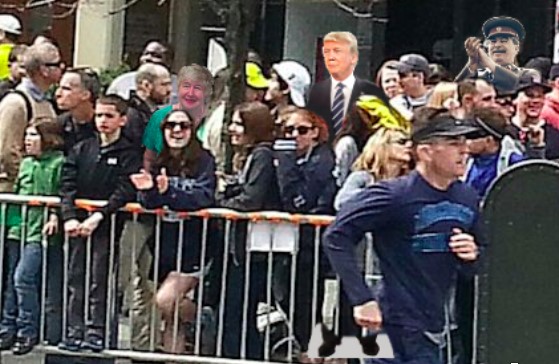
I personally have no doubts the Tsarnaev's were framed, that the trial was a travesty of justice or that the whole Boston event was not a 'deep state' fabricated event.
Despite a lorry load of evidence pointing that way, a young man sits in a federal prison on death row, a device no doubt to ensure his silence.
Previous articles have dealt with the substantive issues of effectively state malfeasance and murder of at least two individuals, the following raises further questions as to the reliability of the photographic evidence submitted in support of the prosecution.
The article is not mine and I do not necessarily agree with. or am persuaded by, all the points made and some are more credible than others, but what is clear is that the event itself was fraudulent, persons other than the Tsarnaevs were responsible for its planning and execution, and that Jahar's defence was non-existent to the point of criminality.
This is yet another stain on American security organisations and jurisprudence that undermines them around the world. 9/11 proved neither the FBI, Department of Justice or Congress itself can be trusted when it comes to State crime of gigantic proportion. The Boston Bombing and the egregious prosecution of the Tsarnaevs is another that only America can put right.
TSARNAEV TRIAL – A PICTORIAL CRITIQUEby Craig AFrom: https://mail.aol.com/webmail-std/en-us/suite |
I have argued that an entirely false story has been mounted against Dzhokhar – Jahar – Tsarnaev. He is not the Marathon bomber. My way of showing Jahar’s innocence is NOT via pictures. It is via the mishandling by a court. I dislike the way Youtubers, such as Peekay, have used photos and videos – who can know their source, and the chain-of-custody?
I asked my friend Ian to fiddle with the picture above. He inserted Trump to the right of Jahar’s hat, and inserted Josef Stalin (who died in 1953) at the top right. Ian hadn’t tried photo-shopping before – that’s how easy it is to do. This picture is at 755 Boylston St. It was shown to the court (without Ian’s additions!). But did it contain Jahar as an “addition”? I don’t know. It was tendered as evidence that Jahar was at the place where a bomb was found.
Jahar was supposedly near the Richard family. Look at the three persons on left, leaning on the railing – Jane, who suffered an amputation, Martin who died, and his Mom. Some have noted that Jane has very straight hair yet in photo minutes later it’s curly.
I have no intention of using pictures to find the bomber. Chapter 30 will discuss the deceptive use of a reenactment by National Geographic. Still, let’s walk through some the official pix now.

Here is a clear shot of the brothers, allegedly at the 2013 Marathon. Most likely it was taken BEFORE 2013. Note Tamerlan’s lack of a beard. His family insists that he grew a beard for religious reasons in 2012 and never shaved it off. I think Jahar, too, is looking a bit young there. The facial features seem OK. I guess it tp be a real shot of the Tsarnaev;s but INSERTED like Trump and Stalin.
Now for a picture of Tamerlan supposedly taken at the Marathon, which was shown in Court. I can’t see the face well enough to judge, but the body does not seem heavy enough for Tamerlan.

Any normal defense attorney would have that photo tossed right out as the context is not discernable. Supposedly it was taken on Dartmouth St. Oh, really?
The following shot was frequently run as a video on TV as proof that the brothers were at the Marathon. No one was asked to explain why the boys were walking single file. Or how there would be so much empty space in which to parade oat such a crowded event. (I tried to attend the 2019 Boston Marathon starting at 2pm. It was so crowded you could not get near it.)
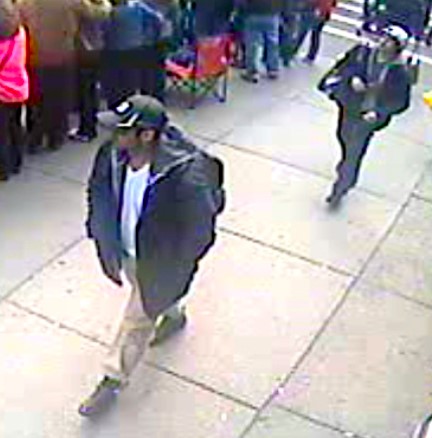

….
Jahar and sister Ailina have a resemblance. Both siblings have a similar chin, but it doesn’t stick out as much as the chin of the “Coram Boy” or “Dorito boy” – as we shall now see.

Court Exhibit 22K
This is the one I call “Coram boy, as it led me to write a petition for Coram Nobis, as described in Document 5 of this book. I said the normally portrait layout of the frame was altered into a square in order to crop out the problematic backpack he had on. Later I judged that it is not Jahar anyway; I believe it is an actor. And I offer the possibility that he is touching his chin to disguise the fact the chin is too prominent to be Jahar’s.
Now look at “Dorito boy.” This photo is supposed to prove that Jahar went into the Shell station to buy snacks. He too is a chin grabber. Also he may be left-handed, as when we see him take an item from the shelf with his left hand. On the right is, allegedly, Dun Meng making his escape from the SUV while it was parked at Shell. I am guessing, but only guessing, that both are actors.
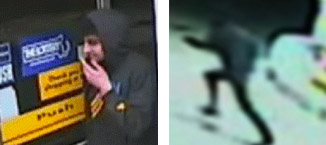

However, I think the photo below is genuinely of the brothers, and so probably taken on a different day. (Tamerlan is in the black circle, standing outside the shop.).

En route to Shell, Jahar allegedly stole from an ATM. I feel sure it is not Jahar. It’s from a surveillance video that includes footage of this boy walking into the bank’s little foyer. I don’t think Dorito boy is the same person as Coram boy, or ATM boy! Talk about body doubles, did Jahar have body triples? IMA12
Next, I offer these family pictures so you can compare Jahar’s facial features with “ATM boy.”

A typical batch of groomsmen. Red-vested Jahar seems to be best man
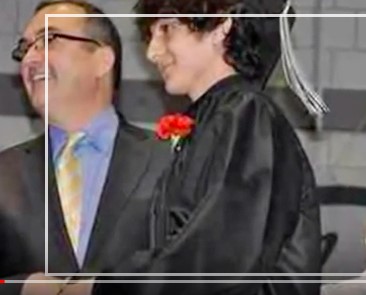
Graduating, Rindge and Latin
In a dishonest world you can’t believe anything. There’s a surveillance video of brothers coming down stairs at their gym, which the voice-over says was near the day of Marathon. I doubt it. In it Jahar looks only age 17 or so.
And then there’s the naked man video that Gabe Ramirez of CNN narrated in a live broadcast in the wee hours of April 19. It is Tamerlan, according to his family, yet the court ignores it. (Note: in Appendix A of this book “the zoologist’s” gives real-time notes of what was being said on radio that night.)
What the Court Provided
Jurors were shown images intended to support 10 claims:
- that both boys walked on Boylston St at the 2013 Marathon
- that Jahar stood near 8-year-old Martin Richard
- that Jahar put a backpack on the ground with a bomb in it
- that Jahar talked on his cell phone at the crucial time
- that the boys walked away, not panicking like the others
- that the boys killed MIT cop Sean Collier, to get his gun
- that Jahar used Dun Meng’s ATM card to steal $800
- that they parked Meng’s SUV near the Shell station pumps
- that Jahar bought snacks at the Shell convenience store
- that the brothers shot at cops on Laurel St.
To repeat, I think all evidence provided by the prosecution to convict Jahar is garbage, notably: the cuckoo story of the brothers bothering to carjack when they already had a car, or the one about choosing to purloin a gun from an MIT cop, or the one about Jahar running over Tamerlan. I don’t suggest that the above pix have any bearing on the unworthiness of the case. The case was already a paragon of unworthiness.
Note: If any if the fake Jahars or fake Anybody’s would like to confess, I am all ears. No doubt they did not know that their five-minute acting job could land a fellow millennial on Death Row. It would also be nice to hear from any (or all) of the groomsmen. They probably knew Jahar well enough to know that he not only didn’t have the motive to bomb the Marathon, he also did not have the brains. They can gmail me at MaxwellMaryLLB.
Subscribe to:
Posts (Atom)