We are a coalition of concerned local residents, environmental groups and health professionals asking that Cornwall Council and the members of the Strategic Planning Committee defer their consideration of Penzance Heliport from the meeting on 28th June in order to give time to investigate several serious outstanding issues.
We are writing this open
letter because we do not feel we are being heard.
We absolutely agree that
Scilly needs robust and reliable transport links and that they have
at times been let down in the past.
1. However, there are several
unresolved issues. These cannot be dealt with between now and the
28th June 2018 and so a pause in the planning application process is
vital to avoid any decision made being legally unsafe. Since
aircraft noise is exempt from noise nuisance control there will be no
possibility of restricting operations once planning permission has
been granted.
An independent
acoustic assessment (May 2018) by Applied Acoustic Design (AAD)
concluded that “without further clarification and further
information, it would be unsafe to base a decision to grant planning
consent for the heliport on the WYG report”. WYG have responded
but failed to clarify how the use of high background noise readings
taken from busy road junctions accurately reflects the loss of
amenity for the majority of the 15,000 people, within 2.5km, who
live in quiet residential areas. The 55dB noise contour needs to be
properly determined, accounting for the reflective properties of the
sea, the amphitheatre shape of Mounts Bay and the fact that the
aircraft when fully loaded will need to hover and rise to 250 feet
before they can move away. Furthermore, reference should be made to
the University of Salford Report (NANR 235, 2008) entitled Research
into the Improvement of Management of Helicopter Noise. This
states clearly that much of the nuisance from helicopters is caused
by their low frequency and impulsive noise, that flight events fewer
than 1 per hour can be highly annoying and that helicopters should
be regarded as 15dBA more annoying than fixed wing aircraft. WYG is
wrong to conclude that overflights will cause no significant harm.
Airports Commission
guidelines from 2014 need to be complied with in order to properly
quantify the psychological and physical health impacts on those
living within the 55dB contour. Reference should be made to the
Lawton and Fujiwara review of 2016 (Living
with Aircraft Noise) and the CAA report of
2016, Aircraft Noise and Health Effects
(CAP1278). Estimations should be made of the predictable loss in
quality of life and increases in cardiovascular and cerebrovascular
disease for those living within the 55dB contour. Gulval School is
1000m from the site. There is clear evidence that noise nuisance at
this level can cause cognitive impairment in children. The WYG data
suggests 1,300 people will be affected. Our view is that the noise
impact is understated and that the figure is likely to be more than
5,000. This is a critical concern and requires independent review.
Helicopter emissions
exceed those of other modes of transport. We call on the Council to
commission an independent study examining the health and
environmental impacts from harmful emissions, including NO2 and
particulate matter.
Since 11th May, local
opposition to the Heliport has increased by 151% (from 33 to 84). To
date, despite reasonable requests from concerned local residents, a
public meeting on the planning application has not yet been
convened, contrary to Cornwall Council’s planning protocol.
95% of registered
support is from holidaymakers who do not live in Cornwall and who
have been canvassed for their support. There should be a breakdown
of the data to demonstrate the true level of local support. The
desire of holidaymakers for increased convenience must be
appropriately balanced against the permanent harm to health that
will result from this development.
On the natural
environment impacts, Natural England have stated in its May 2018
submission that “significant effects cannot be ruled out”. We
call for the impact on the environment and wildlife to be properly
and independently assessed.
The current proposal
is for 80 hours flying time over 7 days compared to the pre 2012
level of 60 hours over 6 days. This represents a significant
escalation of the previous noise nuisance. Airports Commission
guidelines make it clear that Cornwall Council has a duty to
mitigate harm and all health and wellbeing consequences should be
properly quantified to enable the necessary degree of mitigation to
be calculated. This still needs to be done.
For the above reasons, we
call on you – as our locally elected representatives – to listen
to the local community, defer your judgment and ensure you arrive at
the right decision for all stakeholders.
Yours sincerely, Signed by local GP and five others.
Israeli television recently aired a video of two Israeli soldiers filming themselves in the act of shooting a Palestinian protester at the Gaza boundary while cheering. Filming one’s own crimes against humanity – shooting Palestinians for sport – suggests a sense of security in never being held accountable.
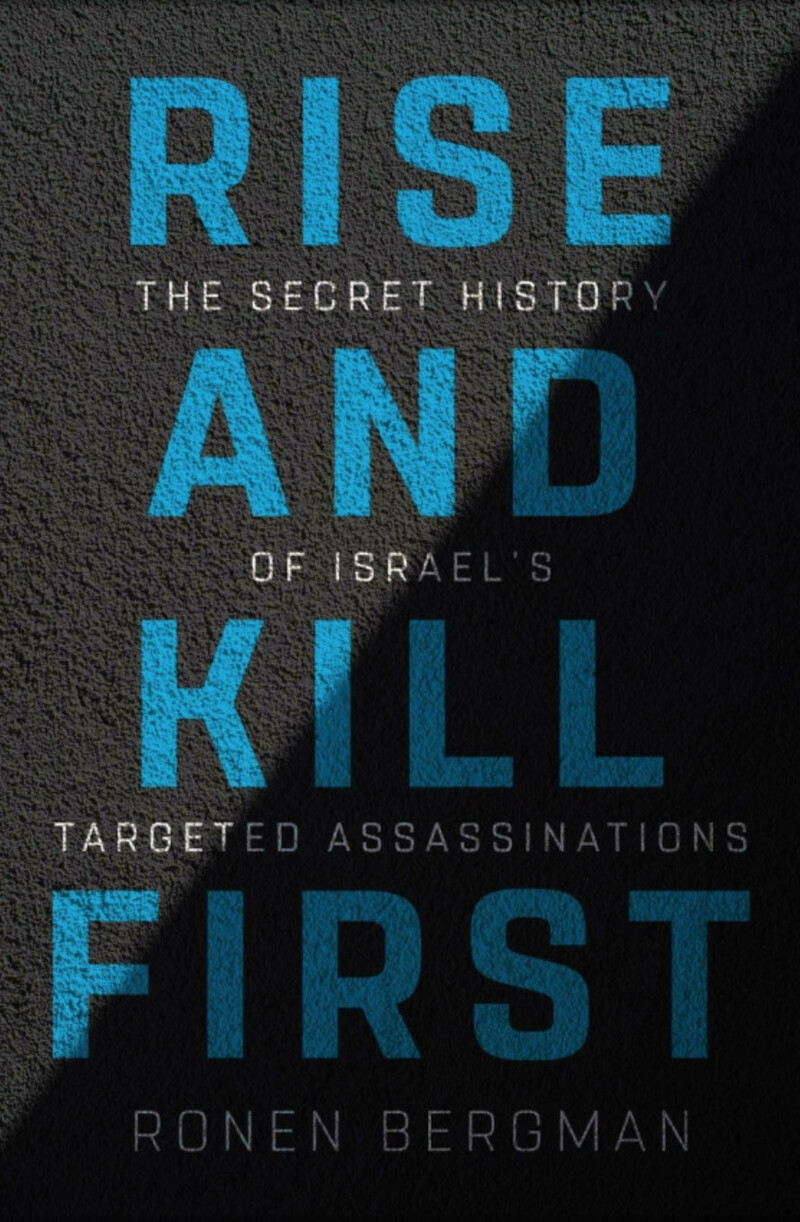
Even more evidence of this impunity is apparent in Rise and Kill First: The Secret History of Israel’s Targeted Assassinations by veteran Israeli journalist Ronen Bergman, staff writer for The New York Times Magazine.
Prosecutors at the International Criminal Court might want to consider this book Exhibit A if Israeli government and military officials are ever indicted for war crimes. It contains open admissions of guilt in plotting and executing extralegal assassinations in violation of international law.
“Since World War II, Israel has assassinated more people than any other country in the Western world,” Bergman writes. In many cases, these so-called targeted killings over the last two decades also involved the deaths of nearly a thousand bystanders, according to Bergman’s calculations – those numbers, however, fail to include the tens of thousands killed in overt acts of war and collective punishment that mostly go unmentioned in this book.
That Israeli officials were willing to be quoted and identify others by name implies a certainty of never being held accountable in a court of law. Consider, for example, the instruction given by former Israeli Prime Minister Ariel Sharon to Avi Dichter, at that time Shin Bet’s director, in reference to Hamas. Sharon, in an open admission of intent to commit genocide, stated: “Go for it. Kill them all.”
It was not just assassinations. Bergman writes, “‘state security’ was used to justify a large number of actions and operations that, in the visible world, would have been subject to criminal prosecution and long prison terms: constant surveillance of citizens because of their ethnic or political affiliations; interrogation methods that included prolonged detention without judicial sanction, and torture; perjury in the courts and concealment of the truth from counsel and judges.”
Rise and Kill First details the lengthy history of Israeli political assassination, dating back to British Mandate Palestine. It includes the period of the so-called Border Wars (a term used by historian Benny Morris in his book Israel’s Border Wars, 1949-1956), the formation of the Palestine Liberation Organization in the 1960s, the Israeli invasion and occupation of Lebanon in the 1970s, the first and second intifadas in the occupied territories beginning in the 1980s and the ongoing military campaigns against Hizballah, Syria and Iran (the so-called Radical Front) that continue today.
As the decades went on, assassinations became increasingly frequent, in part due to improved surveillance through drones and computer technology, enabling intelligence agencies to carry out hundreds of operations per year as opposed to only a few previously.
“Collateral damage”
The book’s title derives from the Talmudic command that a person has the right to “rise and kill first” as a preemptive measure.
This concept formed both the moral and legal basis for the policy, which many human rights groups consider invalid under international law because execution without trial makes a mockery of due process and erases the distinction between combatants and civilians. Many of the victims were political and even religious figures who were most likely not involved in planning attacks against Israel, Bergman asserts.
The Haganah – the paramilitary precursor to the Israeli army – defined assassinations as “personal terror operations,” targeting leaders of the Palestinian national movement. After 1948 all of Israel’s intelligence agencies, including the military intelligence department Aman, the Mossad and Shin Bet, became involved in extralegal killings.
The assassination policy allowed for the murders of Palestinians and other Arabs simply because they were part of the resistance against Israeli settler colonialism.
The people killed to avenge the holding of hostages and deaths of Israeli athletes at the 1972 Summer Olympic Games in Munich, for example, indicate that Israeli intelligence simply picked out leaders or representatives of the Palestine Liberation Organization, not those directly involved in the Black September group that planned the abduction. Palestinian Wael Zuaiter, who was translating One Thousand and One Nights from Arabic to Italian while living in Rome and serving as a local PLO representative, was one of the murder victims, as was a misidentified Moroccan waiter living in Lillehammer, Norway.
That a racist code existed is undeniable, particularly given the distinction Israeli intelligence officials often made between “collateral damage” involving Arabs and non-Arabs: If Arab bystanders or family members might be killed, the operation was still likely to be given the go-ahead; if non-Arab bystanders might die, it was to be avoided. As Bergman notes, “as long as the targets were located in enemy countries, and as long as the innocent civilians were Arabs, the finger on the trigger became quicker.”
Israeli government and intelligence officials even planned the downing of commercial airliners in the hope of assassinating leading PLO officials. Although the plan was never implemented, Israeli officials developed an elaborate scheme to shoot down such aircraft in radar-free zones over the Mediterranean Sea so that discovery of the wreckage would be more difficult and the crime conceivably concealed.
News accounts seized on a separate incident detailed by Bergman in which the planned downing of an aircraft believed to be carrying PLO Chairman Yasser Arafat was narrowly averted in 1982. The plane was carrying wounded Palestinian children, and Arafat was not aboard.
Missing the point
Many of Bergman’s revelations are so shocking that one wonders why an apparently loyal Israeli journalist would expose them. But he is hardly the first reporter to venture into the realm of exposing the secrets of intelligence agencies, even if they tarnish the state’s carefully cultivated image.
The rationale is usually that the documented crimes represent “mistakes” that the exposé hopefully corrects without fundamentally challenging the nature of the state that carries them out. This journalistic genre largely misses the point. Intelligence agencies are not gatherers of information to protect state security, but are rather covert actors engaged in implementing the state’s hegemonic ambitions by any means necessary.
Intelligence agencies protect their secrets. It’s the rare journalist who can ferret them out by diligent investigation.
Most often, intelligence or government officials themselves leak secrets because of policy disagreements, splits within ruling factions or political ambitions. Bergman acknowledges this fact and makes it obvious that his principal source was the late Meir Dagan, an army general who became head of the Mossad under Israeli prime ministers Ariel Sharon, Ehud Olmert and Benjamin Netanyahu.
Unfortunately, Bergman is little more than a transcriber, bringing minimal analysis or historical background. For example, Dagan’s covert program to assassinate Iranian nuclear scientists is cited as a better method than overt military action to halt Iran’s alleged nuclear weapons program. The diplomatic negotiations that resulted in an international agreement and a rigorous inspections regime for Iran’s nuclear program are simply ignored.
The book has numerous other failings as well, including giving short shrift to the efforts of Israeli human rights organizations to halt extrajudicial killings and framing the Israeli narrative in a way that omits the numerous acts of collective punishment carried out against the Palestinian people since 1948. The words “collective punishment” appear only once in its 784 pages in reference to a home demolition.
Omitted are references to Deir Yassin and the dozens of other massacres that occurred during the Nakba of 1948-49, the massacre at Khan Younis in 1956, the numerous military provocations Israel carried out in Syria’s Golan Heights prior to the 1967 war and Israel’s flagrant violations of the ceasefires with Hamas in Gaza in 2008, 2012 and 2014 that resulted in the deaths of thousands, including children.
Rendition and torture
To his credit, however, Bergman does delineate the similarities between the Israeli and US intelligence agencies, including recruiting journalists as spies, setting up false-front organizations to interfere in other countries, working with ex-Nazis and helping identify left-wing political activists under authoritarian regimes for the purpose of having them tortured or murdered.
Aman’s Unit 504, which engaged in kidnappings, anticipated the CIA’s rendition and torture program following the 11 September 2001 attacks. And Bergman makes it clear that both former Secretary of State Condoleezza Rice and National Security Advisor Stephen Hadley under President George W. Bush approved and supported the Israeli assassination policy.
Ultimately, the belief in the effectiveness of extrajudicial executions rests on the idea that individuals, not social forces, make history: Eliminate a single person and history is changed. Following the killing of a Hizballah leader, Bergman reports that some in Israeli intelligence came to recognize that “Hizballah wasn’t one-man’s guerrilla force – it was a movement … a legitimate grassroots social movement.”
Bergman makes the dramatic claim that Israel’s intelligence agencies, having come to realize the futility of an assassination policy against Palestinian resistance, embrace the two-state solution, leaving them at odds (though “quietly”) with the current Netanyahu government. Dagan, in particular, appeared to have been motivated to leak some of Israel’s most damaging secrets due to a rift with Netanyahu over his opposition to a Palestinian state.
The likelihood of an eventual binational state if the two-state solution failed was an outcome that Dagan feared more than anything. In one of his last remarks at an Israeli political rally, Dagan explained his worries: “I do not want a binational state. I do not want an apartheid state. I do not want to rule over three million Arabs. I do not want us to be hostages of fear, despair and deadlock.”
After reading Rise and Kill First, one wonders: Had Dagan lived, would he have ordered the assassinations of those advocating a binational democratic state?
Rod Such is a former editor for World Book and Encarta encyclopedias. He lives in Portland, Oregon, and is active with the Occupation-Free Portland campaign.
(Well done the West. Yet another success story. Can it be coincidence that this also happened to Iraq and Syria and that Iran is now in the cross hairs?)
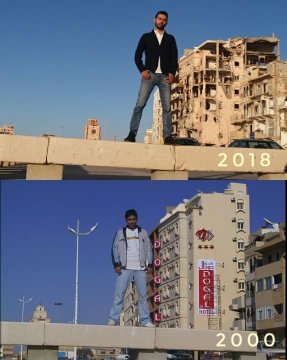
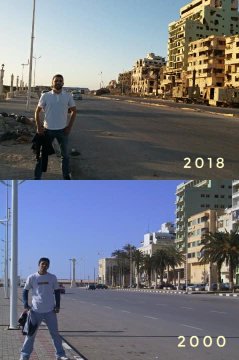
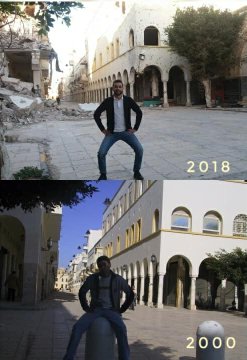
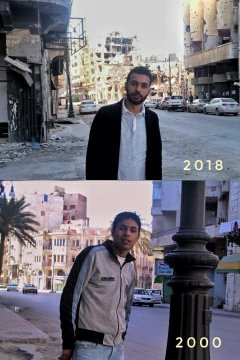
A Libyan man who took photos of himself posing at various spots across Beghazi in 2000 has revisited the same locations 18 years later to photograph life under the new "NATO liberated" Libya.
The "before and after" pics showing the utter devastation of post-Gaddafi Libya have gone viral, garnering 50,000 retweets after they were posted to an account that features historical images of Libya under Gaddafi’s rule between 1969 and 2011.
It appears people do still care about Libya even if the political elites in Paris, London, and Washington who destroyed the country have moved on. Though we should recall that British foreign secretary Boris Johnson was caught on tape in a private meeting last year saying Libya was ripe for UK investment, but only after Libyans "clear the dead bodies away."
We previously detailed in Libya's Slave Auctions And African Genocide: What Hillary Knew how Libya went from being a stable, modernizing secular state to a hellhole of roving jihadist militias, warring rival governments, and open-air slave auctions of captured migrants.
Yet what the viral photos confirm is that Libya was once a place of sprawling hotels, wide and clean city streets, functioning infrastructure, and lively neighborhoods. But these very places are now bullet-ridden ruins rotting amidst the political backdrop of the 'Mad Max' style chaos unleashed immediately after US-NATO's bombing the country into regime change.
Hillary still says that she has no regretseven after Obama timidly voiced a half-hearted and too-little-too-late Libya mea culpa of sorts in 2016.
Though Hillary's beloved Libyan Al Qaeda ..."rebels" — legitimized and empowered through broad support from the West — are now among the very militias hosting slave auctions and fueling the European refugee crisis, she's never so much as hinted that regime change in Libya left the country and much of the region in shambles. Instead, she simply chose to conclude her role in the tragic story of Libya with her crazed and gleeful declaration of "we came, we saw, he died."
Regime change enthusiasts everywhere please take note of what your blind jingoism has wrought.
* * *
A year before the NATO bombing of Libya the UN Development Programme (UNDP) assigned a Human Development Index (HDI) ranking of 53 to Libya (out of 169 countries ranked, Libya ranked highest on the African continent).
Right up until the eve of NATO's air campaign against the Libyan state, international media outlets understood and acknowledged the country's high human development rankings, though it later became inconvenient to present the empirical data. A February 2011 BBC report is a case in point.
The 2011 war and aftermath created a failed state with a once economically independent populationnow turned largely dependent on foreign aid and relief.
Currently considered to be at "emergency levels" of need, prior to NATO intervention Libya was not even on the Word Food Program's radar, yet is now considered a dire humanitarian disaster zone.
* * *
Among the few editorials written in major Western publications in the midst NATO's war on Libya warning of the consequences to come in real time was a 2011 piece for The Telegraph by Brendan O'Neill.
Though apparently now scrubbed from the internet [this no longer exists on The Telegraph site or in its archives:“The narcissism of the iPad imperialists who want to invade Libya,” Brendan O’Neill, The Telegraph (blogs), 25 February 2011], O'Neill's article is worth revisiting.
The article is preserved and quoted extensively in the book, Slouching Towards Sirte: NATO's War on Libya and Africa, which contains essential summary context laying out the role that international media played in 2011 and after in lying the public into war.
Below is an extensive excerpt from O'Neill's "The narcissism of the iPad imperialists who want to invade Libya"... relevant as ever when in comes to the West's continuing role in Libya, or in places like Syria, Yemen, or Afghanistan.
* * *
In a modern political sphere that has its fair share of narcissists and ignoramuses, no one is quite as narcissistic or as ignorant as the liberal interventionist. From the comfort of his Home Counties home, possibly to the sound of birds tweeting on the windowsill, the liberal interventionist will write furious, spittle-stained articles about the need to invade faraway countries in order to topple their dictators. As casually and thoughtlessly as the rest of us write shopping lists, he will pen a 10-point plan for the bombing of Yugoslavia or Afghanistan or Iraq and not give a second thought to the potentially disastrous consequences.
Now, having learned nothing from the horrors that they cheer-led like excitable teenage girls over the past 15 years, these bohemian bombers, these latte-sipping lieutenants, these iPad imperialists are back.This time they’re demanding the invasion of Libya. In the Guardian Ian Birrell brushes aside the eight-year nightmare of Iraq in one sentence – we shouldn’t be “scarred by the foolishness of the Iraq invasion”, he says – as he calls on the international community to spearhead a “rapid intervention” to save the people of Libya. It’s like an “apocalyptic Hollywood film” and there are even “rumours of systematic male rape”, he says, proving once again that there is no situation so bad that it cannot be made to sound even worse by hacks seeking to emotionally blackmail NATO into dropping a couple of tonnes of bombs.
Over at Slate, a headline sums up the outlook of Libya-concerned liberals: “It’s time to intervene.” Apparently world leaders can send a message to the broader Arab world by getting a grip on the Libyan crisis now. “Before the region descends into protracted civil conflict, the international community has the opportunity, in Libya, to set an important precedent and save thousands of lives in the process.” Meanwhile, a gaggle of human rights groups is calling on the UN and the EU to intervene to “protect Libyan civilians from government killings”. The White Man’s Burden is alive and well, it seems, though it has been thoroughly de-Kiplingised and turned into a super-liberal, PC endeavour.
The ignorance of liberal interventionists is captured in the fact that they seem to have wilfully forgotten the disastrous interventions of the past 15 years, all of which, from Yugoslavia to Afghanistan to Iraq, exacerbated local tensions and led to more, not less, bloodshed. It takes a special kind of arrogance to be able to demand yet another international military venture when the terrible consequences of your last one are still plain to see. And their narcissism is contained in the fact that the real reason they are making these demands for war is to make themselves feel good, to demonstrate that they care with a capital C. They know nothing of the countries that they want to see invaded, and care little about the potential of such invasions to destabilise things further. No, all that matters is that in saying “Forget Iraq, let’s now attack Gaddafi!”, they can publicly demonstrate their own moral indefatigability.